Archive for Author habitatdana

Are You Waging Chemical Warfare in your Yard?

    Silent Spring, that’s what Rachel Carson titled her 1962 book that investigated the disappearance of neighborhood songbirds.  Her expose linking the use of chemical pesticides to the decline of wildlife species, spurred the environmental movement of the sixties.

    We often hear of environmental disasters caused by big companies.  But, many people do not think about how their own actions may contribute to the level of toxic chemicals in our environment.  It is important to realize that “we all live upstream” and chemicals we use may combine and become more concentrated and affect those that live further downstream. Many of our waterways, such as the Hood Canal, are extremely sensitive because of the slow rate at which the water is exchanged and ultimately diluted in larger bodies of water such as the Pacific Ocean.
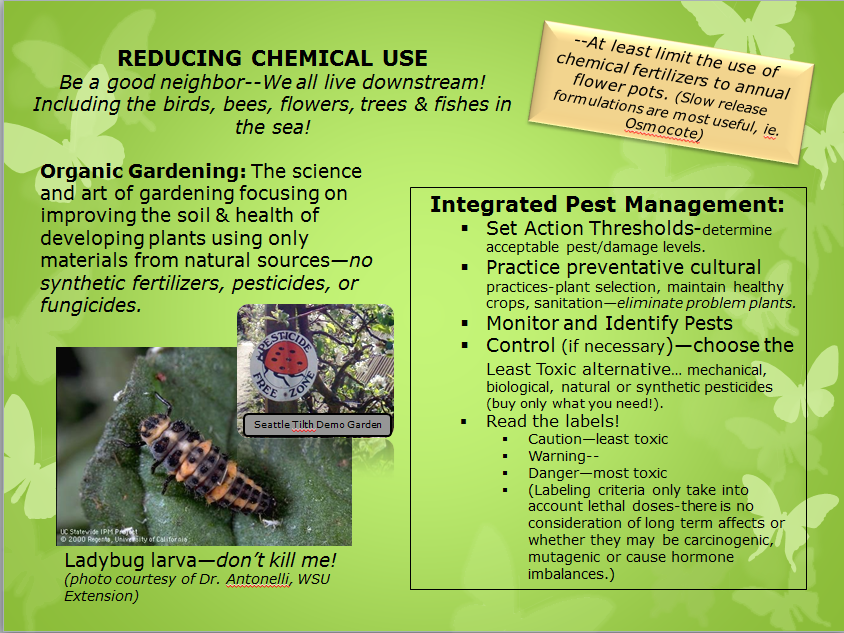
Reducing Chemicals    Gardeners use various types of chemicals in their yards. Pesticides include insecticides, fungicides, herbicides, rodenticides, and slug baits.  Petroleum-based chemical fertilizers, although generally not as toxic as pesticides, can cause severe problems in lakes, rivers and bays, encouraging algal blooms and limiting the amount of oxygen for fish and other animals.

    The best way to avoid using pesticides is to grow plants that are not as susceptible to insect damage and disease.  I curse my apple trees because all I ever get are scabby, wormy apples.  On the other hand, I love my plum tree and blueberry bushes.  They produce bountiful crops with little care!  If you grow troublesome species such as apples or roses, try to select varieties that are disease resistant.  If a plant becomes too much of a problem it is better to be ruthless with the plant and replace it with something else than to spend the time and money on chemicals to kill its pests.

    Make sure you diagnose plant problems correctly.  Don’t be in a rush to spray at the first sign of a “bug” or a little nibbling.  Try to tolerate a little damage.  The problem may take care of itself naturally.  Be able to recognize beneficial organisms such a ladybug larva.

    Baits are preferable to spraying because they limit exposure to nontarget organisms.  If you decide to spray, use the least toxic alternative.  Read the Label!  Chemicals labeled Danger are highly toxic, Warning means moderately toxic, and Caution means mildly toxic.  These warnings, however, will not tell you if it is carcinogenic or mutagenic, only how many lab animals it killed in testing.  Only buy the amount you need, following the recommended application rates, at the proper time– no matter how desperate you are to eradicate the pest!  Avoid “double-duty” products such as “weed & feeds.” Also, just because a product is from a natural source does not mean it is safe, although it may be less persistent in the environment.

    I rarely use any chemicals in my yard any more.  My resident garter snake population takes care of most of my slugs.  In my gardens, I use only Tagro, compost, and organic fertilizers.  The use of slow-release chemical fertilizers is limited to my container plants.  I do, however, spray my foundation when necessary to discourage Carpenter Ants from eating my house.  Weeds present the biggest challenge to avoiding chemical use.  Planting groundcovers and mulching discourage some but there are always plenty of weeds that need to be pulled! 

    Reducing chemical use in the garden requires tolerance of some other organisms—such as insects and weeds.  Maybe, eventually, you can convince your neighbor that, to save our planet, it’s not so important to have a perfect, weed-free lawn!

(This article was first published in the Peninsula Gateway on Apr 15, 2009 as Is there Chemical Warfare in your yard?”
How to Plant Native Plants

Before you Plant

Make sure the plants you have selected are appropriate for the site you are preparing. Take into consideration how large the plants will get and whether they prefer sun or shade; moist or dry soils. Drainage problems should be corrected or plants chosen that are adapted to soggy sites. If selecting plants from outside your area make sure they will thrive in your climate zone. Consider the amount of maintenance the plants will require. Avoid plants known to be susceptible to insects or disease (or increase your level of tolerance for damage). Fall and winter are the best seasons for planting, but planting can be done year-round as long as plants are irrigated sufficiently. Irrigation, especially during the summer, is necessary until plants are well established. Pruning requirements should be minimal if plants are selected wisely. Natural branching patterns are the most attractive! Ideally, native plants will ultimately require little or no care in their recreated natural habitat.

Soil Preparation

Most native trees and shrubs can be planted into the native soil with no site preparation. Some shrubs, especially rhododendrons and other broadleaved evergreens, benefit from the incorporation of organic matter (at least 6 inches deep) into the soil prior to planting. Compost, Tagro, fine bark, and animal manures are examples of organic materials that can be rototilled into the bed before planting. If a rototiller is not available, organic matter may be incorporated into small areas using the double digging method, where a spade is used to mix soil amendments into the existing soil by systematically turning the soil and amendment together, shovelful by shovelful over the entire area. Herbaceous perennials and annuals, especially those found in the forest understory, will benefit from a similarly prepared planting bed. Note, when amending the soil, the whole area needs to be improved, not just the hole in which you plant the plant.

Finalization of the Design

Set the plants into the places where you plan to put them. You can make changes, even if you are following a plan made by a professional. When landscape designing, nothing helps more than actually seeing the plants in place! Stand back and look from different perspectives. Use the principles of design such as scale, form, texture, color, focus, and balance to envision the most attractive arrangement of the plants in your overall design within the surrounding area. Try to visualize how your landscape will look in different seasons and in years to come. Make sure you space the plants allowing for growth. Adjust the placement of the plants until you are satisfied with the aesthetic appearance of your design.

Digging the Holes and Preparing Root Ball

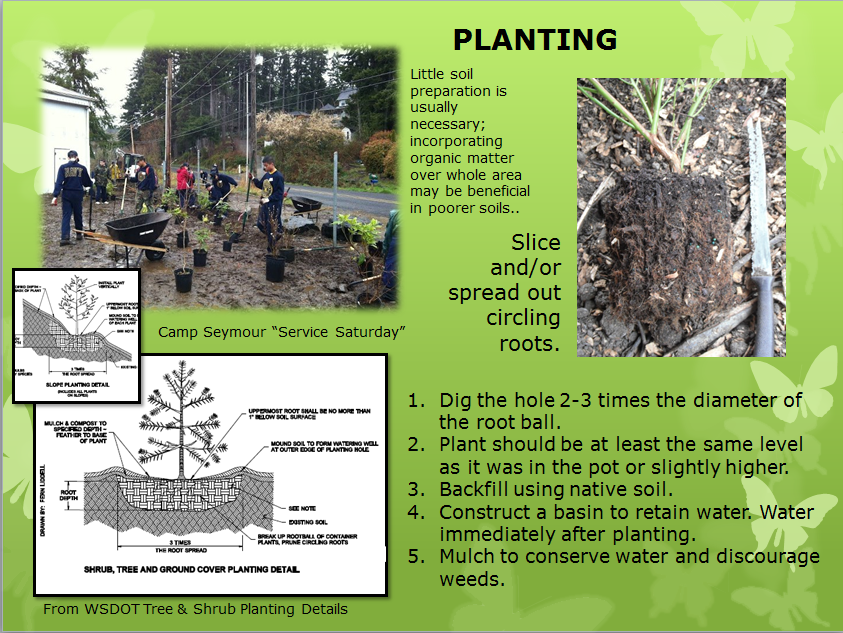
Move the plant out of the way in order to dig the hole. Dig a hole at least twice the diameter and just as deep as the root ball. Pop the plant out of the pot. Any circling roots must be cut and/or spread to prevent the plant from girdling itself in the future and to hasten root growth into the soil of its new location. If the root ball is only lightly rooted, the roots may be gently massaged or spread out with your hands, or fingers. Plants with a fair amount of circling roots, with some soil still visible, can be slashed with six to eight vertical cuts using an old hand shears, knife or shovel.

If the roots are totally matted on the outside of the root ball and no soil is visible, it is beneficial to shave away all the matted roots from the sides and bottom of the root ball with a knife. If there are large circling roots they need to be cut away with a hand pruner or lopper and/or spread out so new root growth expands out away from the plant.

PlantingPlanting

Place the prepared root ball into the hole. Adjust the depth of the hole by digging deeper or replacing soil until the plant will be at the same soil level or a little higher than it was originally growing. Planting too deep may cause problems relating to air exchange with roots and/or disease problems when too much moisture is kept in contact with the stem. Back fill with native soil. Backfilling with other soil amendments may create a constantly wet condition leading to root rots or it may inhibit roots from leaving the nicer soil with the result of containerizing the plant, leading again to circling roots and stunted growth. You want the new roots to grow into native soil and become established in its new location as soon as possible. Tamp the soil lightly, making sure any large air pockets are filled. Use extra soil to create a basin around the plant to facilitate water penetration into the soil.

After Planting

Plants should always be watered in as soon as possible after planting to settle the soil and eliminate any air pockets. Mulching with organic mulch (bark, straw, leaves etc.) helps to keep in moisture, prevents erosion, and discourages weeds. Planting spreading groundcovers, although expensive initially, will save you a lot of future labor by out-competing weeds once they have grown to fill in the area. Pruning should only be done to remove dead, diseased, or rubbing branches, or to balance out the canopy. Cuts should always be made to the next biggest branch, leave no stubs! Remember, Topping is for desserts not for trees. Fertilization may help newly planted trees and shrubs, but should be done sparingly. Nitrogen is usually the only supplemental nutrient needed by woody plants. Chemical fertilizers are expensive and if over-applied can leach and pollute watersheds. Organic fertilizers are generally safer, but may take a little longer to show results. If the leaves on a plant are light green, yellow or smaller than normal, application of nitrogen may be indicated. The best time to fertilize is just after plants begin to grow in the spring. Applications may be made in late fall, late winter and early spring but some loss of nitrogen may occur. Do not use fertilizers containing herbicides. Subsequent irrigation of new transplants is necessary whenever sufficient rainfall is absent for several days not just in the summer, (July and August are the driest months in the Northwest. ) Lastly, enjoy the beauty of your plants in your naturalized landscape and any wildlife that may visit the new habitat you have created!

Staking

Staking is only necessary if the plant cannot stand by itself or it is likely to blow over in strong winds. Evergreens or deciduous trees with a large canopy are most at risk. Drive two stakes into firm ground and tie the stakes with nonchafing material. Inspect frequently. Stakes should be removed when the root system is firmly anchored, usually after one growing season.


Special Habitats

   Old growth forests are especially important habitats if only because very few remain due to logging and development.  According to Arthur Kruckeberg in “The Natural History of Puget Sound Country,” it takes at least 175 to 250 years for a forest to begin to look like an old growth forest.  It is in its prime between 350 to 750 years. Some individual trees may live to 1000 years old or more.  If we make an analogy to human life spans as we do for dogs (7 “Dog-years” are said to be loosely analogous to 1 human-year). A hundred year-old forest wouldn’t even be a teenager yet!

   An old growth forest actually has a greater diversity of life due to the accumulation of biomass and increased shrub & herb layer due to openings from fallen trees.

Special Habitats    Disturbed habitats are also important because they allow different plants and animals to prosper.  Hardwoods are only common on disturbed sites or special habitats such as riparian zones.  Red Alder & Big-leaf Maple are the most widespread.  Black Cottonwood, Oregon Ash, Big-leaf Maple, Red Alder are found on riparian & wetland areas.  Pacific Madrone & Oregon White Oak are found on drier sites.

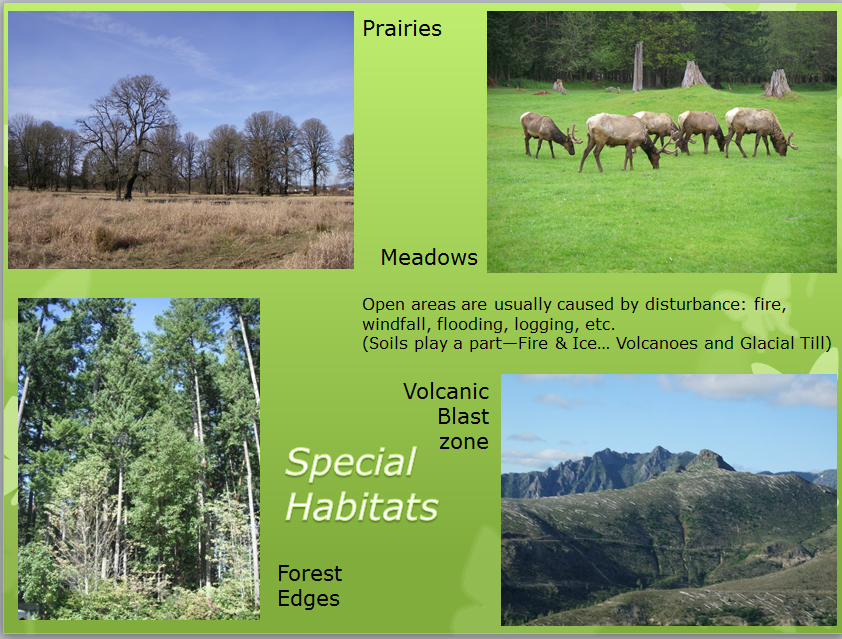
    Prairies usually occur in drier areas and where the soil cannot retain much moisture or fertility. Meadows can be found in areas of frequent flooding, after forest fires, or where trees have fallen within a forest. A forest edge is an extremely valuable habitat for many wildlife species. It is an area that provides nesting sites and cover from predators. It may provide food in the form of berries, seeds, nuts or browse.  Or, it may just be an area of transition for species that move between the forest and meadows.

   The destructive nature of forest fire was thought to be totally detrimental for much of human history; this idea spurred the Smokey the Bear ad campaigns of the 1940’s & 50’s and the construction of lookout towers in national forests. In more recent decades, ecologists have become aware that natural forest fires are often beneficial, opening up areas that allow other organisms to move in to “restart” ecological succession. Small forest fires also reduce the “fuel load” which could cause larger, more destructive forest fires in the future. And, in fact some tree & shrub seeds need fire to be released from their cones or to break through hard seed coats before they can germinate.

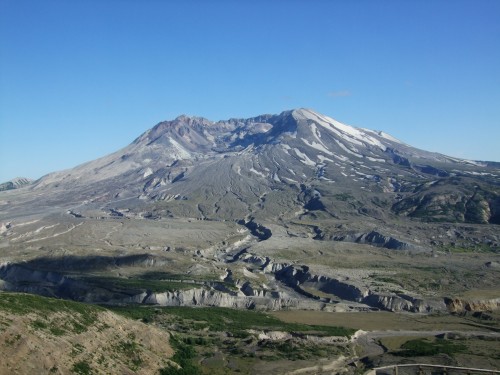
   We have been able to witness the recovery of ecosystems after forest fires and even after huge, widespread disasters, such as the eruption of Mount St. Helens. Life returns to recolonize, starting anew. Just as in the whole history of life on earth, the descendants of organisms that survive mold the living landscape. The interactions of each species contribute a strand to the web-of-life as each competes for earth’s precious resources.

Wetland Habitats

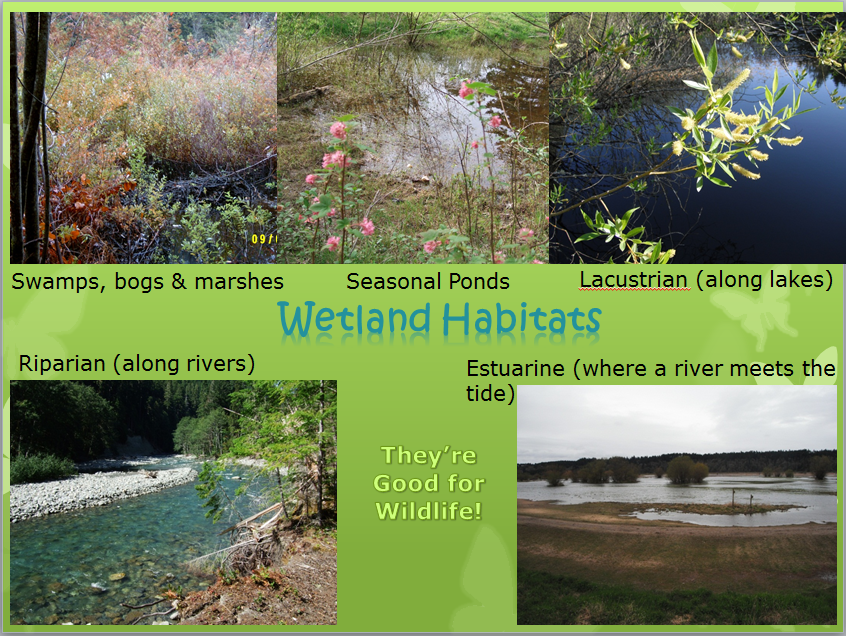
    Water is essential to all life as we know it. All plants, animals and microorganisms need water; although how much they need and how often they need it varies between species. Wetlands are the only place that fish, tadpoles, other amphibians and many invertebrates can survive. Other species live nearby so that they can access the water or prey on the species that live there or that come to congregate at the local watering hole.

Wetland Habitats   Amphibians, such as frogs, are considered an indicator species of the health of a habitat; they are very sensitive to pollution. Swamps, seasonal ponds and lakes are all important habitats for amphibians. Numerous insects and other invertebrates provide food for larger animals in all wetland habitats. Riparian habitats are important for salmon and animals that feed on salmon. Estuaries are important for many crustaceans, mollusks, and water birds.

Vegetational Zones

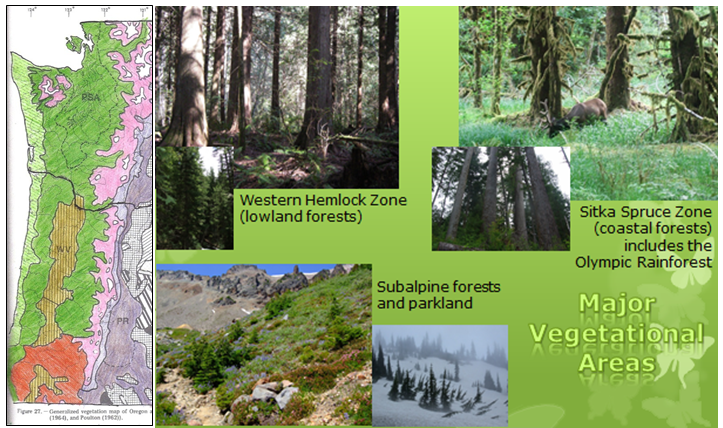
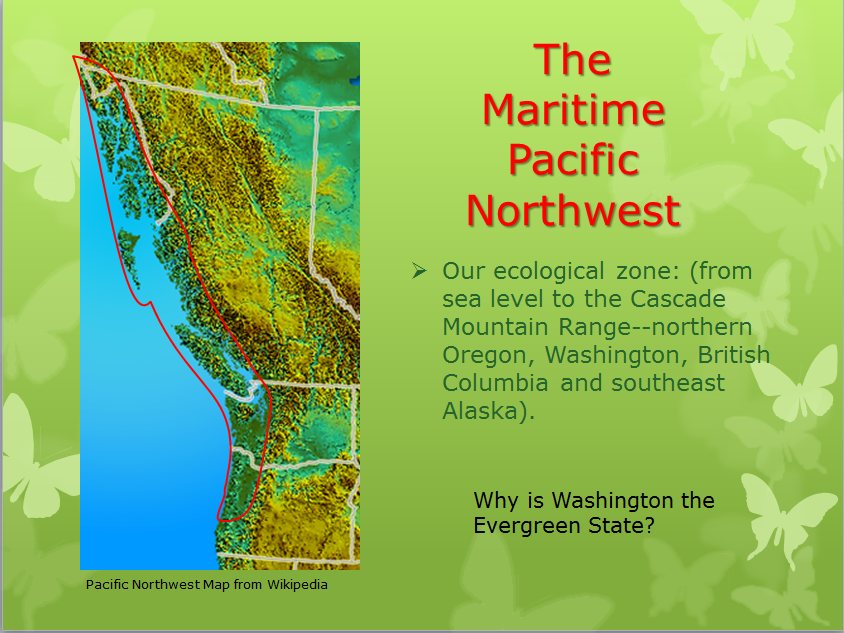
    Ecologists separate our region into major vegetational areas– the Puget Sound Area (PSA) is a special region within the “Western Hemlock Zone” (See figure above). The Western Hemlock Zone  lies between the coastal Sitka Spruce Zone  and Subalpine Forests , extending from British Columbia to the northern California coast.  Alpine regions  are at the highest mountain tops. Heading east there is a narrow Mixed Douglas Fir/Grand Fir Region , then a Ponderosa Pine region  before transitioning to drier steppe habitats. In Oregon, the Western Hemlock Zone is split by the drier Willamette, Umpqua & Rogue Valleys  nestled between the Coast Ranges and Siskiyous to the west and the Cascade Mountains to the east. Southwest Oregon is primarily a mixed Conifer & Evergreen Region .

   The Western Hemlock Zone is named for its climax species, which is the species that theoretically would come to dominate, barring any disturbance.  Today, Douglas Fir often is dominant due to logging, burning or other disturbances that have occurred over the last 200 years.–but even old-growth stands retain several Douglas Firs because of their longevity (750-1000 years or more!).

     The three major coniferous trees found in the Western Hemlock Zone are Douglas Fir, Western Hemlock, and Western Red CedarGrand Fir, Sitka Spruce, Western White Pine are also found sporadically.  Western White Pine & Shore Pine are common on glacial soils in the Puget Sound.  Western Yew is subordinately found beneath the canopies of larger conifers.


Soils & Geology: Fire & Ice

    Before we think about planting, it is a good idea to consider what kind of soil we are planting in.

     Most of our soils in the Pacific Northwest arise from the interplay between volcanoes & glaciers.  Volcanoes bring magma up from underneath the earth’s surface.  The magma becomes lava as it erupts from a volcano and then cools to become igneous rocks.   Glaciers erode the rocks as they move down the mountain.  These massive rivers of ice grind rocks into smaller and smaller pieces.

    The Puget Sound was created from the action of glaciers advancing and retreating over many Ice Ages.  Just 20,000 years ago, the Puget Sound was covered in a mile-high sheet of glacial ice.Soil Physical Properties

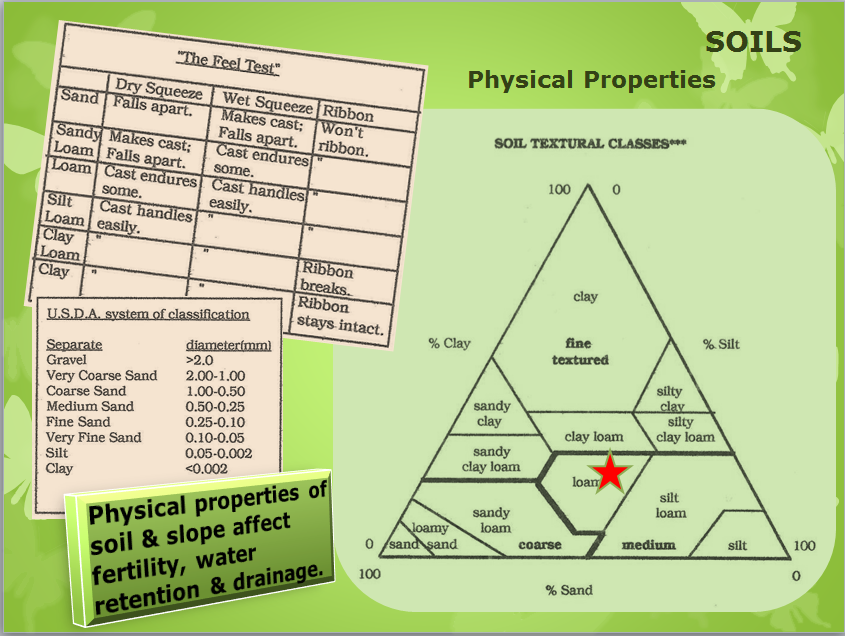
    The type of soil you have in your yard will influence your success in growing different plant species.  The figure above shows the USDA classification system for soil particles.  For growing plants, we are mainly interested in the portions that are sand, silt or clay.  Sand, by itself drains quickly and is not able to retain many nutrients.  Silt is intermediate in size between sand and clay.  Clay, by itself, prevents water from draining, but clay particles are good at holding nutrients.

    Soils are also classified by the relative percentages of sand, silt and clay as indicated by the Soil Textural Class Triangle. Loam soils, the most ideal, have about 33% sand, a 25% clay and 42% silt.

     You can “guesstimate” your soil class by doing a feel test.  For the feel test you take a small amount of soil and squeeze it in your hand.  When you open your hand, you look to see how well the soil holds together.  If it holds together, try to pinch the cast between your forefinger and thumb to a make a flattened ribbon to determine the amount of clay.  If your soil has too much sand or clay, you may want to consider incorporating appropriate constituents to improve its structure.

     The pore space between the particles is important for drainage and for gas exchange. Sometimes soils become compacted due to heavy traffic either by foot or by machines.  Rototilling helps to loosen, aerate and mix soil but only to the depth of the rototiller. (It also helps to make removing weeds easier.) Some gardeners shun rototilling and depend upon natural systems to keep their soil pliable.

      Composted organic matter is also an important component of soils.  It is any material derived from a living organism.  It adds nutrients, increases nutrient-holding capacity, moisture retention and encourages microbial activity.  A soil high in organic matter usually has a dark, rich color.  Organic matter may be added to soils as green manures (cover crops) that are plowed in prior to planting, or by incorporating animal manures or compost.  Many soil mixes used in horticulture, especially potting mixes, are “soil-less.”  They may contain compost, peat moss, bark, perlite, pumice and/or vermiculite.   A “green” alternative to peat (which is mined out of ancient bogs) is coconut fiber (coir). 

   Another important factor affecting plant growth that people often overlook is soil pH; pH is the relative acidity or alkalinity.  It affects what nutrients are available for uptake by plants.  Most plants prefer a slightly acid soil (pH 5.5-7.0).  On a scale from 0 to 14, Seven is neutral, the pH of distilled water; less than 7 is acid; greater than 7 is alkaline.)  It is a good idea to test your soil, especially for pH.  Test kits list recommended pH ranges for various crops and will tell you how to calculate the amount of amendments, such as lime, that should be added to your bed.

   The microfauna, (bacteria, algae, fungi, insects, and worms) of soil also is important.   Charles Darwin studied and wrote a book about worms, “The formation of vegetable mould, through the action of worms.” The book is about the important role that worms play in decomposing and translocating organic matter in the soil and aerating the soil.  He writes: “I was thus led to conclude that all the vegetable mould over the whole country has passed many times through, and will again pass many times through, the intestinal canals of worms. Hence the term “animal mould” would be in some respects more appropriate than that commonly used of “vegetable mould.”  Many bacteria, fungi and insects are also “decomposers.”  Some bacteria help plants by “fixing” nitrogen; absorbing it from the air and making it available to plants.  Some fungi, such as mycorrhizae assist plants with nutrient and water uptake.  Algae play a role in dissolving minerals.

    Epiphytes, plants that grow in trees do not need soil–they are able to absorb water and nutrients directly from the air.  Most plants that we grow, however, are terrestrial plants, plants that grow in soil.  (I have never been very interested in “high-tech” horticulture such as hydroponics—such systems are expensive, involve mixing a concoction of water soluble chemicals and are unnecessary as long as there is space to grow plants naturally in soil).

   The plants and trees also affect the fertility of the soil as layers of organic matter are deposited and decomposed by the action of microorganisms.

Feature Photograph: Mt. St. Helens


Why do Evergreens predominate in the Coastal Pacific Northwest?

Maritime PNW    Climate plays a major role in determining what plants can be found naturally or can survive in any location.  As children we learn that there are different types of habitats found throughout the world: deserts, grasslands, and various kinds of forests.  I used to wonder why conifers dominate our forests here in the Pacific Northwest.  In other areas of similar latitude– the eastern United States, Europe and Asia–deciduous forests predominate.  Evergreen coniferous forests are usually found at more northerly latitudes.

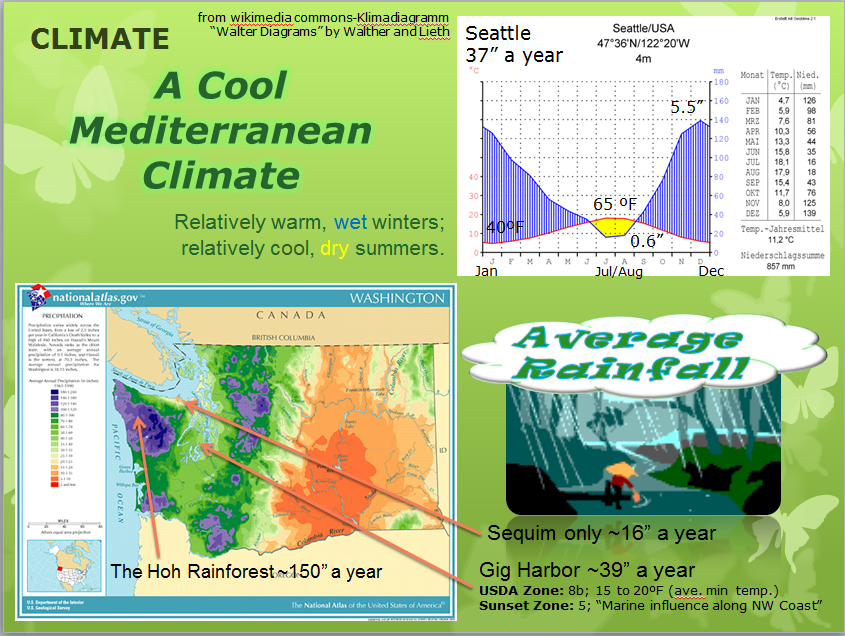
    Most people believe that it rains in Seattle and the Pacific Northwest year-round, although it does rain much of the year, our great secret is that it is usually dry and sunny (but not too hot) in July and August.  The weather patterns in the Pacific Northwest are influenced by its proximity to the Pacific Ocean.  Our maritime climate is characterized by relatively warm, wet winters and relatively cool, dry summers.  In the winter, warm, moist air from the southwest flows into the area, as the air cools, the moisture precipitates as rain (or snow if it gets cold enough).  In contrast, cool, dry air coming from the northwest, delivers little rain in summer.

The Diagram on the upper right shows average rainfall and average temperature--The yellow zone indicates a typical dry period.

The Diagram on the upper right shows average rainfall and average temperature–The yellow zone indicates our typical dry period.

  Dry summers can cause severe plant stress.  Newly planted landscapes are especially vulnerable.  It is a common sight to see dead plants in new landscapes that were not irrigated sufficiently.  If you plant in July and August, it is important that the new plants are watered adequately but not overwatered!  Any plants that were grown in a greenhouse or shadier locations will need to be “hardened off” before planting.  This is done by exposing them incrementally to outdoor temperatures and increasing light levels a few weeks before planting.  “Sun leaves” need to grow to replace”shade leaves,” which will burn in the hot sun.

   Evergreen plants are able to grow whenever there is adequate water and favorable temperatures.  If it is too dry they close the small pores, stomates, on their leaves that allow gas exchange, halting photosynthesis.   Evergreen leaves are waxy and often small to minimize moisture loss through epidermal surfaces.  Dormancy can occur when it is either too cold or too dry. 

   Evergreen Huckleberry (Vaccinium ovatum) and Salal (Gaultheria shallon) are the dominate undergrowth shrubs in our second-growth lowland conifer forests.  They are both outstanding plants for the landscape that are adapted to our dry summers; with beautiful evergreen leaves prized by the florist industry and berries prized by people and wildlife.

    Many of our native evergreens, although adapted to wet winters, do not do well with summer irrigation; examples include: Pacific Madrone (Arbutus menziesii), Snowbrush, (Ceanothus velutinus), Hairy Manzanita, (Arctostaphylos columbiana), and Oregon Boxwood (Paxistima myrsinites).  Pacific Rhododendron (Rhododendron macrophyllum) and Oregon Grape (Mahonia aquifolium) can withstand some irrigation.

    In some parts of the world, such as Madagascar and Costa Rica, there are summer deciduous forests, where shrubs and trees lose their leaves in the summer! Our deciduous trees and shrubs prefer moister areas near streams and rivers.  If summer has been too dry, they too will start turning color early and start shedding leaves before fall has even arrived. 

    The end of summer or beginning of fall is a good time to start planning new landscapes, so that you are ready to start planting as soon as there is regular rainfall. Trees and shrubs planted in fall and winter have a better chance of survival because they are able to grow roots into surrounding soil using stored food reserves.  But remember, even natives may need supplemental irrigation the first couple of summers!

(This article was first published in the Peninsula Gateway on September 8, 2010 as “Dry summers are expected in the evergreen state.”)


Soil Preparation is Important for Successful Gardens

     Buying plants on impulse or over-ordering seeds is hard to resist for an avid gardener.  You should have a location in mind before purchasing and make sure the soil is prepared in the selected location before planting. It is much easier to start with a good soil than trying to amend it after planting!

    Most trees and shrubs require little preparation as long as the soil is well drained and topsoil hasn’t been removed due to construction activities.   If you have a drainage problem, you may create a berm (a hill) to raise the soil level or select plants tolerant of “wet-feet.”  Evergreen shrubs such as rhododendrons and heathers need organic matter incorporated into the garden bed prior to planting.

    Use soil that was dug out of the hole for backfilling.  Nicer soil placed in the hole discourages the plant’s roots from growing into surrounding soil and may cause problems in water movement.  Top-dress with fertilizer and mulch after planting.  Don’t forget to water!

    Herbaceous flowers, herbs and vegetables are fussier.  You need soil with a proper balance of moisture retention and drainage as well as the ability to hold nutrients.  Sandy soils drain too quickly and will not retain nutrients.  Clay particles are good at holding nutrients but a clay soil won’t drain.  Loam, with a mixture of particle sizes, is ideal.   Moisture and nutrient retention is also improved by the addition of organic matter. One example is coconut fiber (coir); it is the “green” alternative to peat (which is mined out of ancient bogs).

    It is often difficult to be sure that soil you buy will be of good quality.  Soil companies sell soil as 3-way or 5-way mixes, however there is no standard as to what goes into these mixes.  Usually they contain loam, compost, peat, sand, bark, and/or sawdust, (sometimes weed seeds!).  Before ordering, visit the company to see samples.  Bagged soil also varies in quality; I always look for broken bags so I can inspect the actual soil before I purchase a bag as well as read the label to determine the actual soil constituents.

Potting Mixes

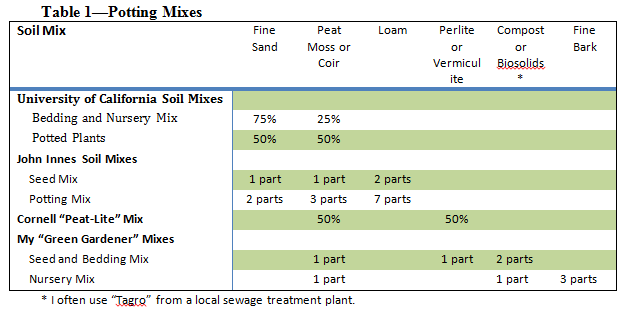
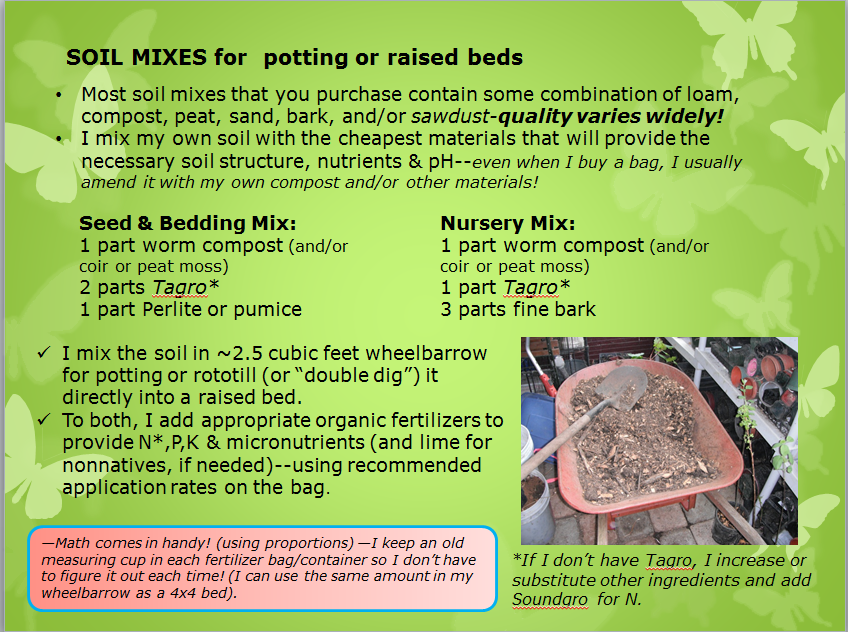
    Table 1 shows examples of various potting soil recipes.  Many growers use two or three different recipes; one for nursery stock (woody plants), another for growing bedding plants (herbaceous flowers, herbs, vegetables, and house plants), and perhaps a third for germinating seeds.  I purposely omit the chemical fertilizers in an attempt to encourage the use of fertilizers from natural sources.

    I usually mix my own soil.  Even if I buy it, I amend it with my own worm compost, biosolid products from local waste treatment plants, other “organic” fertilizers and sometimes perlite.  Tagro is produced by the Portland Avenue sewage treatment plant in Tacoma.  Made from biosolids, sawdust and sand, it is free if you shovel your own.  For a minimal cost you can have it dumped into a truck or trailer, or have it delivered.  I believe it is the highest and best use of this material–and it grows big beautiful plants!  Often I will simply mix Tagro and fine bark mulch in my raised garden beds. You can also purchase premixed potting soil.Soil Mixes

    It is a good idea to test your soil, especially for pH—we usually have acid soils. Test kits list recommended pH ranges for various crops and will tell you how to calculate the amount of amendments, such as lime, that should be added to your bed.

   “Soundgro” is a granular fertilizer produced by Pierce County’s Chamber’s Creek treatment plant—I use this for nitrogen when I don’t use Tagro.   I have used rock phosphate for Phosphorus, greensand for potassium (K) and kelp meal for micronutrients.  Follow recommended application rates– more is not always better! Cedar Grove Compost is also a good product made from recycled yard waste in the greater Seattle area. Look for other recycled waste materials in your area. These soil amendments are usually a cheap alternative to chemical fertilizers.

    When you start with a good, nutrient-rich soil, it is easier to grow healthy vegetables, flowers and landscapes!

(This article was first published in the Peninsula Gateway on Jan. 20, 2010)

Mary, Mary, Quite Contrary, How Does Your Garden Grow?


My Home Garden

My Home Garden

    In the1880 U.S. Census, the occupations of 41% of the Heads of Households were listed as Farmer, Farm Laborer or Farming.  Of those that had other occupations, you can bet that most of the wives or other members of the family had kitchen gardens and livestock.  Growing and preserving food took a lot of time and energy.  When my grandparents moved to California in the 1920’s, my grandmother put all her preserves in the back of the car and covered them with a blanket to make a place for my uncles to take their naps.  During the depression, she canned 50 quarts of peaches from a tree in the backyard.

    In today’s economy, most people purchase the food they eat.  Although much of our food is grown in the United States, more and more of it is from other countries.   As I attempt to reduce my own carbon footprint, I have been paying more attention to where my food originates.  As a Washingtonian, I was dismayed to discover that some packages of dried apple snacks came from China.  Isn’t it contrary or even dangerous to our own survival, when we build warehouses on our best farmland, to house imports from other countries?

    Across our country, many residents are challenging municipal ordinances that prohibit the raising of farm animals.  My mom was a city girl from southern California, but her family always had chickens.

    Farming and gardening is labor intensive, but it is worth it if you can grow some of your own fresh, pesticide and preservative-free, animal products, (such as eggs), fruits and vegetables.

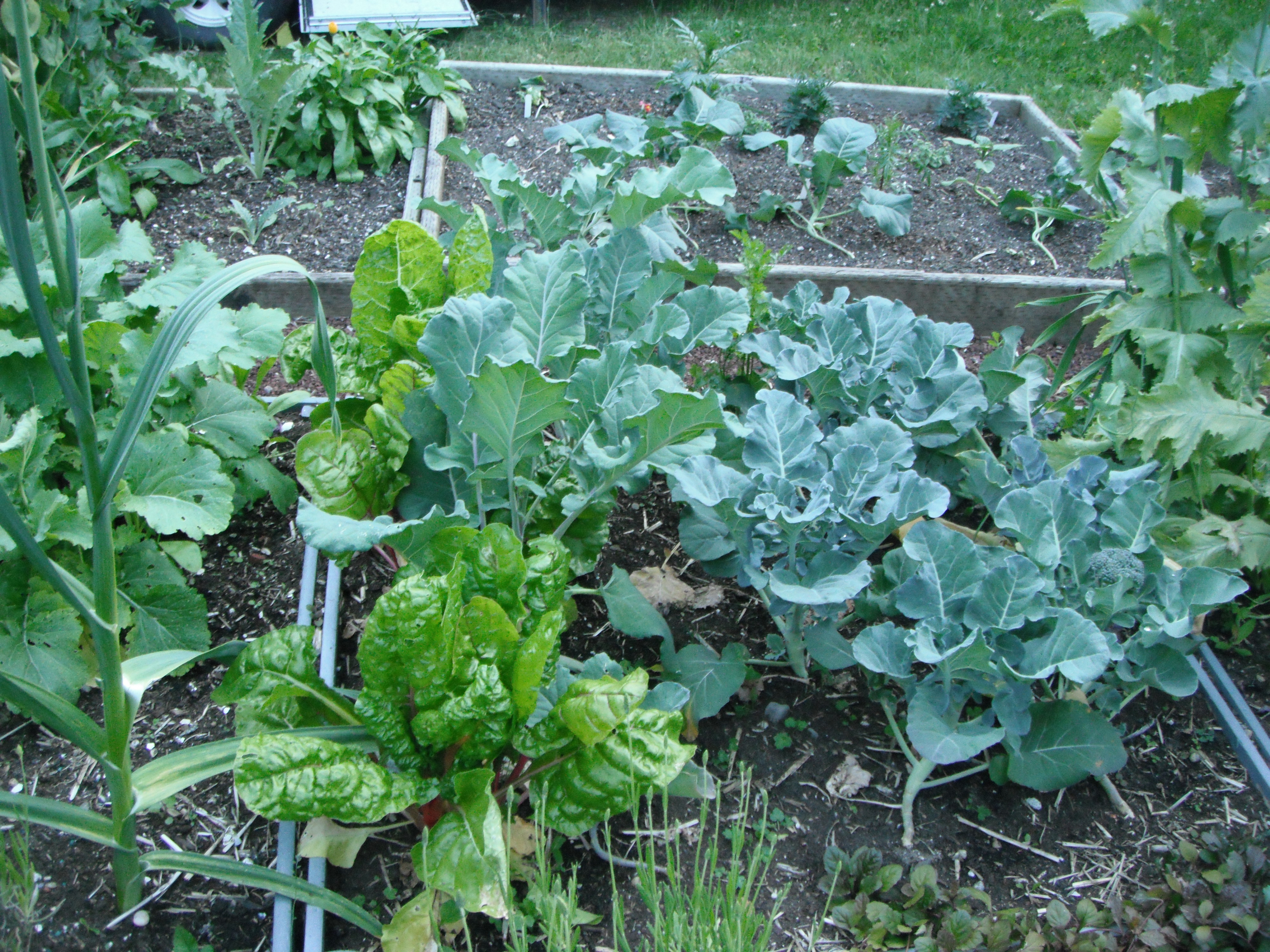
Swiss Chard & Broccoli plants in my garden.

Swiss Chard & Broccoli plants in my garden.

  If you haven’t started a garden yet this year, you may still be able to buy starts at a nursery or a farmer’s market—or start planning a winter garden.  Use a seed catalog to help you plan.  Territorial Seeds from Oregon, specialize in varieties that grow in the northwest.  When deciding what to grow, you want to grow fruits or vegetables that will yield a crop that is higher in quality and value than what you could buy in the store.  High quality vegetable crops would include: asparagus, Brussels sprouts, onions, peas, summer squash, or tomatoes; high value crops would include: broccoli, cucumbers, leaf lettuce, peppers, or rhubarb.  Fruits that are easy to grow include: strawberries, blueberries, raspberries, and plums.  Raintree Nursery in Morton specializes in fruits that grow in the northwest.  –Most importantly you need to grow what your family likes and will eat.  As you become more experienced as a gardener, you will learn what grows best for you in your location.

    You can preserve your produce by freezing, canning or drying.  Most vegetables need to be blanched (plunged in boiling water for a few minutes) before freezing; otherwise enzymes can make them bitter.  Canning takes a bit more knowledge, but fruits like peaches and pears are not difficult, and even pickles are fairly easy. For jams and jellies, just follow the recipes on the pectin package.  A good book on food preservation will have recipes and important safety tips.

    If you do not have the time for your own garden, shop at a farmer’s market to support local growers, or pay attention to where the produce comes from when you shop at your local grocery store.   Some farmers are creating co-ops—where customers can pay to have fresh, locally grown produce delivered to their house every week.

    Eating locally, sustainably, grown food will help to ensure that we will continue to have access to the sources of energy that sustains our bodies!

     (This article was first published in the Peninsula Gateway on Dec 30, 2009 as Value Makes Farming Worthwhile)

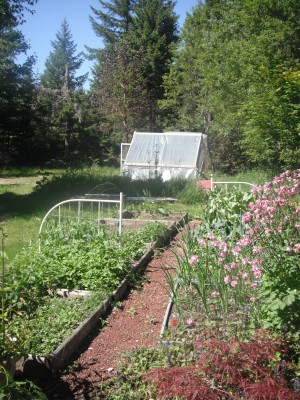
Feature Photograph: My raised-bed vegetable garden & cold frame in the background.

Creating a Wildlife Habitat

    Several months ago, I wrote a column about discouraging pests, such as deer, moles and rodents, in your garden.  I had a reader take issue with my suggestions, such as blocking access to shelter in buildings; removing birdfeeders (temporarily, at least); and managing your trash properly to discourage unwanted diners.  I intended to give people greener options for dealing with garden household pests, not to discourage all wildlife.

    Habitat loss is the biggest cause of species extinction on our planet.  The best way to combat that trend is to protect existing wild ecosystems, to restore disturbed habitats, to limit human population growth and speculative new construction to areas already impacted by development, and to plan landscapes to encourage appropriate native wildlife.

When you plan landscapes, it’s important to not merely focus on aesthetics but to balance the needs of wildlife with the needs of people.  We cannot, however, allow wildlife to decimate our crops or livestock, or spread disease; and although I would be thrilled to see a bear, cougar or pack of wolves at a safe distance, I shudder to think of dangerous close encounters.

    The best way to encourage wildlife is to re-create habitat.  Our national parks and wildlife refuges have rules against feeding wildlife for several reasons, mostly to protect the health and safety of people and wildlife.

    Feeding wildlife disrupts predator/prey relationships.  Studies have shown, for example, that feeding corvids (jays, crows, etc.) can increase the populations of those birds, and they in turn eat the eggs and young of other birds.

   People or pet food is often not good nutritionally for wild animals and can spoil more readily than food they normally wood cache.  Wild food they forage for themselves is best.   

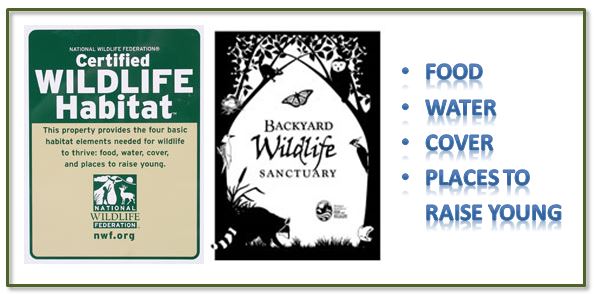
    The National Wildlife Federation’s “Certified Wildlife Habitat” and the Washington Department of Fish and Wildlife’s “Backyard Wildlife Sanctuary” are programs that will officially recognize your efforts to foster wildlife in your backyard.  They are great educational programs for children.

    In order to qualify, you need to do the following:

  • Provide food for wildlife.  Plant native trees and shrubs that produce berries, seeds or nuts, foliage and flowers.  Birdfeeders bring birds up close and are a great way to learn about songbirds.  There is less of a danger for creating a dependency with songbirds, because they can easily fly to other locations to search for food, except when they are nesting.  When you feed the birds, it’s for your entertainment and education, not for them. Burrowing animals and some insects such as butterflies need a wildflower meadow; these smaller animals and insects are prey species for larger predators.
  • Supply water for wildlife.  If you have no natural water feature, you can start by installing a bird bath or fountain.  A pond with plenty of algae and other microorganisms is a necessity for amphibians.
  • Create cover for wildlife.  Wildlife needs places to hide to feel safe from predators and inclement weather.  Evergreen trees, bushy or thorny shrubs, brush piles, cavities in old trees or stumps, niches in rockery, or man-made shelters such as bat boxes all make good hiding or nesting places.
  • Give wildlife a place to raise their young.  Wildlife needs safe places to incubate eggs and raise their young.  Many birdhouse designs are available to buy or build.  The folks at Wild Birds Unlimited in Gig Harbor can help you choose different types of feeders, shelters or houses.
  • Finally, let your garden go green.  Practice soil and water conservation, control exotic species, and garden organically.  Then you can certify your garden as a “Backyard Wildlife Habitat.”

 (This article was first published in the Peninsula Gateway on July 20, 2011 as Garden for People and Wildlife.)


Rodents, and Moles and Deer, Oh My!

    Being an ecological gardener can be challenging.  You want to be able to invite wildlife into your garden; but you don’t want your time and effort in growing your own produce or creating a beautiful landscape wasted just because some little critter ate more than you expected.

    Before you invest in plants and labor, try to anticipate animal pest problems.  If you are in a rural area, or know that a particular animal is present in your neighborhood—use that knowledge when planning your garden.   Alternatively, you should decide whether to continue to try and protect existing plants – or plant something different.  For example, try “deer resistant” plants if deer are a problem.

    Although it is often difficult because many animal pests are nocturnal, identification of the pest that is responsible for damage is essential for effective management.    Deer, rats, mice, voles, moles, rabbits, squirrels, pocket gophers, mountain beavers, raccoons, skunks, opossums, bears, and many bird species may cause damage.  The kind of damage or other signs such as paw prints or scat may help to determine the type of culprit.

   Next determine what are the benefits and costs of control vs. the economic and aesthetic cost of damage.  Also consider the value of the species ecologically, to your neighbors and whether it is legally protected.   Before deciding on a control measure, consider the possible effects on non-target organisms and the environment.

The general types of control methods in order of most ecological (least toxic) to least ecological (most toxic) are as follows:

1)      Elimination of shelter and availability of food and water:  Although not very practical in wilder areas, especially if you are trying to encourage other wildlife species, you should at least block critters from finding shelter in buildings and dispose your garbage and manage your compost pile properly.   Birdfeeders may need to be put away, at least temporarily.

2)      Distractions & deterrents:  You may try planting other fruit & nut species more preferred by wildlife than your food crops.  Scarecrows, owls, fluttering objects, reflectors may work temporarily but birds soon become accustomed to them.  Motion detectors attached to sprinkler systems may scare some offenders away.

3)      Barriers: Wrapping the base of young tree trunks may discourage rabbits or rodents from eating bark.  Placing netting over berry bushes or chicken-wire cages around young plants provides some protection.  You need a fence at least 8 feet tall to keep out deer, especially if you want to grow “deer-candy” such as apples or roses.   For burrowing animals, a barrier can be buried around the area you are trying to protect.

4)      Repellents are products that are sprinkled around or sprayed on foliage to discourage an animal from entering an area or that they find distasteful when they eat it.  Repellants need to be reapplied frequently to replace what may have washed away or to cover new growth.

5)      Traps:  Live traps, although considered “more humane,” leaves you with the problem of where to release the animal after it is caught!  You should be aware that all body-gripping and impaling traps, other than “common rat and mouse traps,” are illegal to use in Washington. 

6)      Baits or poisons:  Extreme care should be taken whenever toxic chemicals are used.  Accidental pet poisoning is tragic.  Also predators such as raptors that eat poisoned rodents could also be at risk.

    If we can alter our aesthetic ideals, it may be easier to learn to live with nature than to fight it.  As long as they don’t threaten our livelihood, allowing other animals to exist enriches our lives

(Some of this article was first published in the Peninsula Gateway on Feb. 2, 2011 as Landscape with Native Plants, for Soil’s Sake.)

« Older Entries Recent Entries »