Archive for 4) Ecological Garden Designs

Landscaping with Native Plants


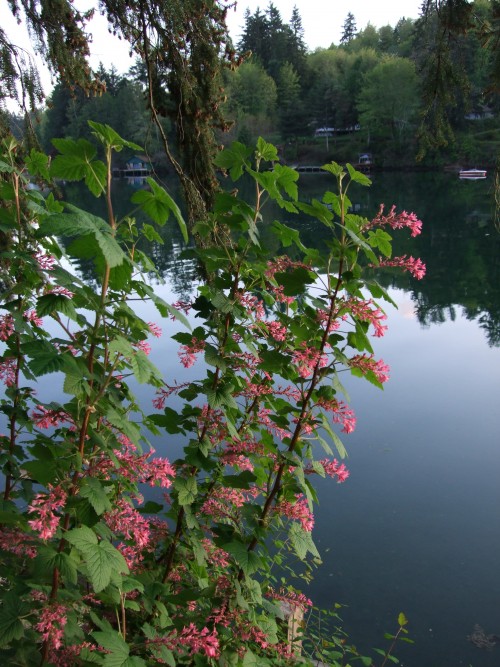
My Favorite Native Plant, Red-Flowering Currant, Ribes snaguineum.

My Favorite Native Plant, Red-Flowering Currant, Ribes sanguineum at YMCA Camp Seymour..

   What is a native plant?  Native plants are plants that grew naturally in a region prior to possible introduction by settlers during territorial expansion.  They were not brought here from other countries or regions either intentionally or accidentally.  Depending on the scope of the discussion native plants can have a wide definition, including the entire United States or a narrower one including only those native to a particular region.  For our purposes, we will concentrate mostly on those native to the northern Pacific Coast from sea level to the Cascade Mountain Range (northern Oregon, Washington, British Columbia and southern Alaska).

    Why landscape with native plants?  Native plants are better adapted to soils and climate.  They usually require less irrigation and less maintenance.  With some exceptions, native plants have fewer disease problems.  Native plants attract native wildlife.  Insects and other invertebrate pests become less of a control problem if there are enough birds, bats and snakes in your habitat to keep them under control.  Native groundcovers can discourage the spread of invasive weeds.  A natural landscape can also be left alone to regenerate itself through natural systems of pollination, seed dispersal and germination. Native Plants visually “fit” better in local landscapes than exotics; and can be used to create enchanting, woodland landscapes.  Many are very attractive.  Some native plants, such as the Red-Flowering Currant, have been reintroduced after cultivated varieties were developed in Europe.

     If your goal is to improve the ecology of your landscape, then a large percentage, at least 80% or more, of it should be natives.  It only makes sense to provide the food, cover and nesting plants with which local animals have co-evolved.  Although some exotic plants may be highly attractive to animals, they are the “candy” that can be useful to entice them to check out your habitat.  Whereas, the native plants are the “staples” that will keep the animals coming back or staying, including your habitat as part of their territory!  You do not need to be a purist and can enjoy a few of your favorite exotics as long as they are not invasive or will otherwise ultimately cause problems.  I usually like to plant my summer annuals in containers so they remain separate and easier to maintain.

    Purchasing Native Plants:  Many retail nurseries now sell some native plants, but they are often limited in the quantity and species available.  It is best to find a nursery that specializes in growing and selling native plants.  Because some native plants do not transplant well, you will have better success with smaller plants that have been grown in containers.  A list of native plant nurseries can be found at the Washington Native Plant Society Website.  Many nurseries have websites where they post what they grow and what is currently available, but it is best to call first to verify availability.  A reputable nursery will only sell container-grown materials or will let you know if the plants were wild-collected legally with a permit.  Many county conservation districts hold annual native plant sales, where larger quantities of small bareroot plants can be obtained relatively inexpensively.
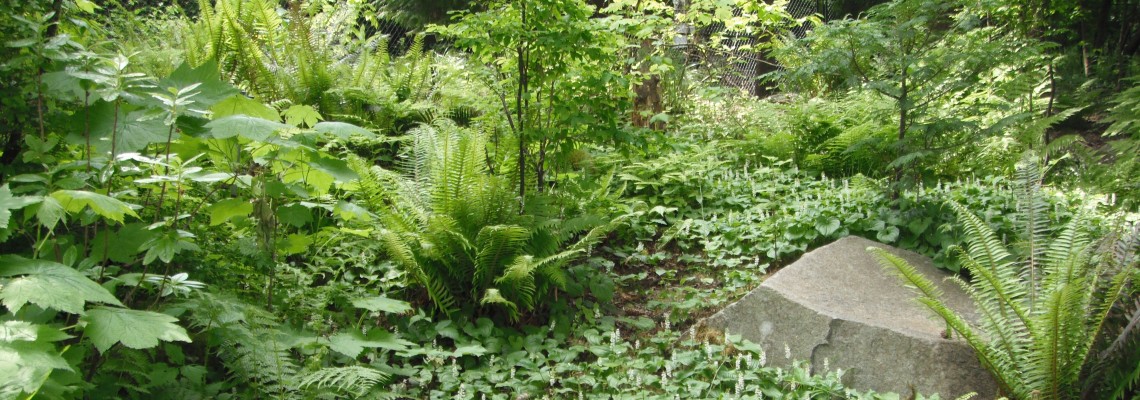
The Native Plant Garden at Point Defiance Park in Tacoma, Washington

The Native Plant Garden at Point Defiance Park in Tacoma, Washington


    Collecting Plants in the Wild: Before collecting plants in the wild it is important to get permission from the owners of the property.  Plant collecting in National Parks is strictly prohibited (permits are issued only for educational or research purposes).  In National Forests, you need to check with the local ranger to find out what can be collected and whether you need a permit.  State parks generally have strict guidelines that, for the most part, only allow plant removal for maintenance purposes.  Whenever collecting in the wild, it is important to be conscientious and only collect where large populations exist and collect only what you can use.  The collecting of seeds or cuttings for propagation is preferred over digging the entire plant.  Some plants, such as most of our native orchids, are better left alone.  Because of complex symbiotic or semi-parasitic relationships, these plants will not survive transplantation.  The best places to collect native plants are sites that are soon to be cleared for development.  There are native plant salvage organizations that use volunteers to go in and rescue plants from these sites.  It is a good way to claim some plants for your own landscape!

    Seed collection and preparation:  Seeds should be collected at the appropriate time, when pods, cones or fruit have ripened sufficiently.  Pods, capsules or cones can be collected just before seeds are released– further drying will often cause them to open so the seeds are easily shaken out and collected.  If the seed capsules are already open and still contain seeds, the seeds can be shaken into a bag.  The preparation of seeds contained in fruit is more time-consuming.  The fruit needs to be macerated (softened and mashed).  Sometimes it helps to allow the fruit to begin to rot in a bag or to soak in water.  To extract the seeds from the fruit, gently mash the fruit to separate the pulp from the seeds in a bowl of water.  Most viable seeds will sink to the bottom and can be separated by swirling the pulp and water mixture and successive decantations, leaving the seeds on the bottom of the bowl.  Some seeds, such as Salal, will float and even resist the surface tension of the water, and need to be skimmed off the surface of the water.  (Sometimes it is easier just to mash the fruit and spread it, pulp and all, onto the growing media.)  For some species, seeds from fruit should not be allowed to dry out but should be planted immediately or stratified as necessary.  For plants that produce nuts, such as hazelnut, it is often difficult to find ripe nuts before squirrels or other animals.  Sometimes nuts are produced that have no viable seed inside, therefore, before going to the trouble of planting these, the nuts should pass the “float test.”  After placing the nuts in a pail of water, only plant the ones that sink to the bottom.  You may crack a few open to check to make sure the test worked properly.

(This article was first published in the Peninsula Gateway on Sep 16, 2009)
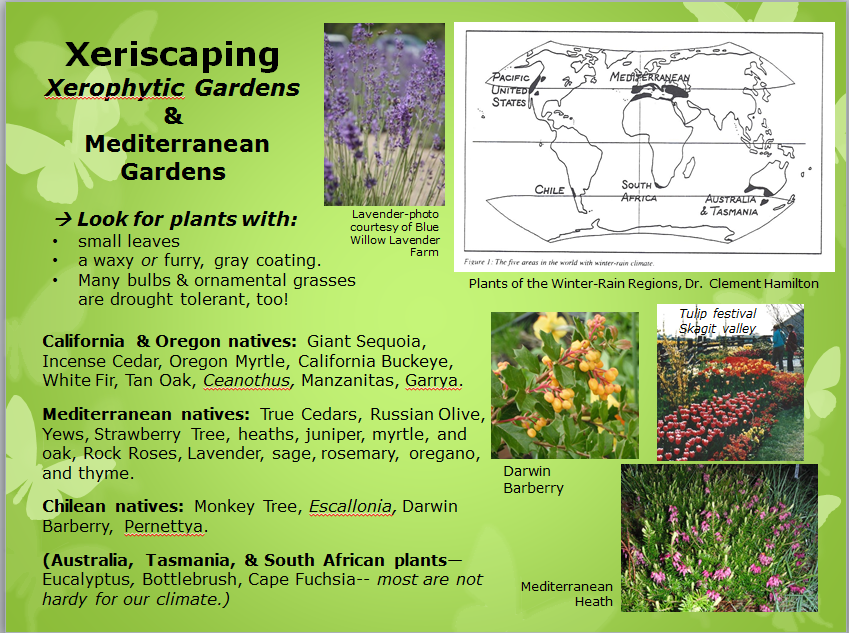
Xerophytic Gardening—reducing irrigation requirements

    Ever wonder why we have predominantly evergreen forests in the Pacific Northwest?  Whereas, at our same latitude in the east, New Brunswick, Canada has mostly deciduous trees that exhibit brilliant colors in autumn.  Most of the world thinks that it rains all the time in our region; but one of our secrets is that we have dry summers.  In regions with summer rains, trees that lose their leaves in the winter, have all summer to photosynthetically replenish their energy.  Evergreens, however, are adapted to be able to photosynthesize whenever conditions are favorable.  Therefore in the Pacific Northwest, evergreens that have limited moisture in the summer can grow at other times of the year. 

    We call our mild, maritime climate, with relatively warm, wet winters and cool, dry summers, a Winter-rain or Cool Mediterranean Climate.  Most other Winter-rain climates are warmer, as found in parts of Chile, South Africa, and Australia.  For plants that may be better adapted to drier northwest gardens, horticulturists look for plants from these regions.

    Although native plants are obviously the best adapted, plants from other winter-rain regions also do well in our drier landscapes.  From Chile: Escallonias have glossy evergreen leaves and small pink flowers; Pernettyas, (Gaultheria mucronata), come in different varieties with shiny berries ranging from white, pink, red, purple to nearly black—all with a metallic sheen; Darwin Barberry (Berberis darwinii) has fountain-like growth with showy yellow flowers and blue berries favored by birds; its spiny stems make it and excellent barrier shrub.  From South Africa, Cape Fuchsia, (Phygelius capensis) has loose clusters of red-orange flowers. From Australia, some of the hardier Eucalyptus trees such as the Cider Gum (E. gunnii) may be successful in certain microclimates.  Several familiar landscape plants come from the Mediterranean including true Cedars (Cedrus sp.), Mediterranean Heaths (Erica x darleyensis hybrids), Strawberry Tree (Arbutus unedo) and the ever-popular Lavender (Lavendula sp.)

    Plants adapted to withstand dry periods usually have thick, waxy leaves.  Hairy leaves provide protection against drying winds.  Gray or silvery foliage reflect some of the sun’s rays.  Look for these characteristics when choosing “drought-tolerant” plants.

    Many regions such as the Southwestern U.S. are facing severe water shortages.  Some conscientious, environmentally responsible citizens that are eliminating water-guzzling lawns and replanting with natives have had to battle homeowner associations because the new look of their landscape, didn’t fit the accepted standard! Currently, in the northwest, we rarely have water restrictions—but we may find them occurring more frequently in the future.

    Add compost to soil to increase water-holding capacity. Mulch to keep the soil cooler and moist longer.  Reduce turf areas by planting native groundcovers or try an “eco-lawn” that requires less irrigation.

     In order to irrigate efficiently, group all water-loving plants.  Create focal points by planting colorful annuals in small areas or in containers.  To determine how long to irrigate, measure how long it takes to fill a tuna can 1 inch deep, take an average of several places, closer and farther from the sprinkler head (different soil types may require more or less).  It is better to irrigate deeply and less frequently to encourage plants to grow deep roots.  Watering during the cooler, early morning hours prevents loss due to evaporation.  Soaker hoses or drip irrigation systems deliver water just where it is needed.  Some of the newest sophisticated irrigation systems have moisture sensors; some can even tie into the Internet and make adjustments using information from local weather reports.

    Remember that any new landscape will have to be irrigated the first 1-3 seasons in order to establish good root systems!

 (This article was first published in the Peninsula Gateway on Aug 5, 2009)

Landscape Design for Energy Conservation

    As energy costs continue to increase we need to look for various, imaginative and logical ways we can reduce the amount of energy we consume.  Often overlooked is how trees and shrubs surrounding our homes can affect the temperature of our living spaces.  Trees and large shrubs can even modulate the intensity and quality of light entering through windows.  We can decrease the amount of fuel used in lawnmowers, edgers, spin trimmers, leaf blowers and hedge trimmers and the air and noise pollution they create, by reducing or eliminating high maintenance turf areas and hedges.

    Computer models used by the Department of Energy predict that just by planting trees in the proper places you can save 25-30% in heating and cooling costs.

     In our climate, keeping your southern exposure open for the greatest solar heat gain is the most important way to reduce heating costs.  We built a greenhouse on the south side of our house to provide passive solar heating as well as for propagating and growing plants.  We angled the glass so that it would be perpendicular to the sun’s rays at noon on the spring and fall equinoxes.  On sunny days, I can just open the door to the greenhouse and allow the heat in—I often do not even need to turn on the furnace on cool, but sunny fall or spring days! 

    For people that live in windy areas, planting a windbreak can also reduce heating costs.  Most of our winds originate in the west from the Pacific Ocean, but every microclimate is different due to varied landforms. The most effective windbreaks are evergreens, with branches that grow close to the ground.  They are best planted at a distance from your home that is 2 to 5 times the mature height of the trees.  For a more interesting, and natural-looking design avoid a single-species—”soldiers in a row” hedge, instead, try a mixed species planting!

    Foundation plantings also help to insulate your home by creating dead air spaces.

    For cooling, one or more deciduous shade trees on the west side of your home can make a big difference in your comfort during the hottest part of the summer.  For maximum benefit, the crown of the tree should shade your house, especially any windows during the hottest part of the afternoon.  I used a sun chart for our latitude to determine that on July 22nd, at 2:30 pm– the sun would be 60 degrees west of true south at an angle of 50 degrees from the horizon.  Therefore, the best position of a shade tree would be at an angle of 60 degrees west of south, from the point where you want the most shade on your house.  The distance should be about ½ to 2/3 the mature height of the tree, perpendicular from your house (if it lies on a north-south axis).  For example, a Red Maple that grows to about 60 feet should be planted 20-30 feet perpendicular from the house or about 25-35 feet along the hypotenuse of the triangle from the spot you want shade.

    Trees are nature’s air-conditioners.  Most (except for some desert plants) are inefficient in the use of water.  As trees draw water up though straw-like xylem cells and use it in the process of photosynthesis, they must open small pores (stomata) in their leaves to take in carbon dioxide, and release oxygen.  During this gas exchange, water vapor is lost to the outside air.  This process, called transpiration, produces a cooling effect.

    With the careful design of your landscape, you can save money and help the environment by reducing your family’s carbon footprint!

 (This article was first published in the Peninsula Gateway on Aug 26, 2009 as Work on your Landscaping to Help with your Energy Efficiency in your Microclimate.)

Why have a Rain Garden?

    The Puget Sound was one of the featured waterways recently covered in the PBS Frontline special “Poisoned Waters.”  Unfortunately, I missed the program, which aired the evening before “Earth Day.”  The Frontline website emphasized that although Puget Sound may look pristine and beautiful on the surface, underneath many chemicals are severely impacting marine wildlife and the food web.  In the past, the biggest polluters were big industrial companies.  Today, most of the pollution comes from small commercial and residential developments; much of it from seemingly innocuous sources such as beauty products, medicines, and household cleaning products that are flushed into our sewers and storm drains.

    A Rain Garden is one of the strategies now being used in the field of “low-impact development” (LID), along with permeable paving, rainwater collection systems and Living RoofsRain Gardens are specially designed to filter pollutants and reduce the amount of water that runs off into storm drains and roadside ditches.  Having a place for rainwater to go may also reduce damage caused by flooding after severe storms.

    The first step to building a Rain Garden is to determine the best locations in your yard by observing where water naturally flows and testing the soil to find out how well it drains. Check out any county or city requirements before you begin–especially for new construction.  Many local governments are starting to require the installation of Rain Gardens for new construction projects.  Also “Call before you dig” to make sure there are no underground utilities at the site.

    The second step is to plan the size and shape of your Rain Garden.  By calculating the square footage of impermeable surfaces such as driveways and roofs, you can determine the percentage of rainwater that will be held or absorbed, depending on the size of your Rain Garden and how well your soil drains.

    To build your Rain Garden, you will need to excavate between 18-30 inches of soil.  If existing soil does not have too much clay, you may incorporate compost and reuse it; otherwise you may need to purchase an appropriate soil mix.  Replace enough soil so you leave about 6 inches of depth for ponding.  Create an entry for the water, making sure that any pipes are appropriately sloped.  Provide a rock-lined overflow.

    Although fall and winter are generally considered to be our best planting seasons, it is recommended to plant a Rain Garden in the summer so that rainwater does not turn your project into a mucky mess.  Select plants for 3 wetness zones.  Native plants are a good choice and are likely to be drought tolerant in the summer.  After planting, mulching helps keep the soil moist, adds organic matter, discourages weeds, and prevents erosion.

     Your Rain Garden should be irrigated the first 2-3 summers to encourage healthy root systems.  Reapply mulch to any bare areas.  Make sure the inlet and outlet remain clear of debris.  Do not apply fertilizers or pesticides; the soil mix should provide adequate nutrients. 

     For more information on Rain Gardens, tours & workshops check out 12,000 Rain Gardens.   A good guidebook is the Washington State University’s Rain Garden Handbook for Western Washington Homeowners. It is downloadable as a PDF.

    By building a Rain Garden, you will create a beautiful garden that not only reduces the amount of pollutants in our watersheds but also helps restore habitat and attract wildlife, such as frogs and birds, to your yard!

  (This article was first published in the Peninsula Gateway on May 13, 2009 as Why have a Rain Garden in Washington?)


Green or “Living Roofs”

    Are you thinking about putting a new roof on your home?  Or perhaps you have a garage or other out-building that needs a new roof.  You may want to consider installing a Green, or “Living Roof.”    We were intrigued by the idea and created one on our cabin.

    A Green Roof provides many benefits.  It can provide increased energy efficiency by adding extra insulation to buildings.  By having one less dark surface absorbing the sun’s rays, and with the addition of transpiring plants, you can help reduce the “heat island effect,” that causes increased temperatures in urban areas.  The growing media and plants absorb water, decreasing the amount of water run-off to storm drains.  By planting a diversity of flowering plants, your Green Roof will attract birds, butterflies and other insect pollinators, thereby creating a charming microhabitat.  Finally, your Green Roof can provide a pleasant view for those who look down upon it.

    There are some important questions to consider before you decide to build a Green Roof.  Most importantly, will the structure withstand the weight of the plants, media, water and a snow load?  Some structural reinforcement may be necessary– you should consult an engineer to be sure.  If the slope of your roof is steep, special frames need to be constructed to prevent slippage.   For slopes less than 2 degrees, adequate drainage is a problem.

    The first step in the actual construction is to build a containment frame with drainage outlets on the lower edges.  Next you will need a waterproof/ root-proof membrane.  (We purchased a pond-liner on “Craig’s List.”)  It is extremely important that you are careful not to make holes in this material and do a good job sealing seams.  For roofs with less than a 10-degree slope, you will need a drainage layer and a filter layer (to prevent soil from clogging the drainage layer).   Next is the growing media.  To limit the weight load, it is recommended that 75-90% of the media is inorganic, such as pumice or expanded clay.  We tested the weights of various mixes and ended up using a mix of 40% lava rock, 40% perlite, 10% compost, and 10% coconut fiber (+organic fertilizers).  The depth (deeper =heavier!) of your growing media will determine what you will be able to plant.  At depths of 2 inches or less, you will only be able to grow mosses and sedums.  At 2-4 inches you can plant short, drought tolerant grasses, wildflowers, and small bulbs.  At 4-8 inches, you can plant taller species and even small hardy shrubs. 

    The biggest expense is the plants and growing media constituents—for us it was the perlite (we kept buying out all the local Home Depot stores!).  I planned ahead and grew most of our plants.  Your costs increase dramatically, if you have to purchase plants and/or pay for the labor to install it.

    There are many resources on the web such as greenroofs.com and livingroofs.org.  A good book to check out is “Green Roof Plants: A Resource and Planting Guide” by Edmund and Lucie Snodgrass.  One thing to keep in mind is that these resources are from other climates.  When deciding on plants to include in your plan, you should choose ones that will thrive in this climate.  I tried to stick mostly with beach, prairie and subalpine natives, and several varieties of sedums, but I also planted various bulbs and scattered miscellaneous herb seeds.

   It was a great joy, last summer, to visit the roof and see the busy activity of the bees and butterflies visiting flowers on our living roof!

(This article was first published in the Peninsula Gateway on Mar. 18, 2009 as A Green Roof can Increase Efficiency.)

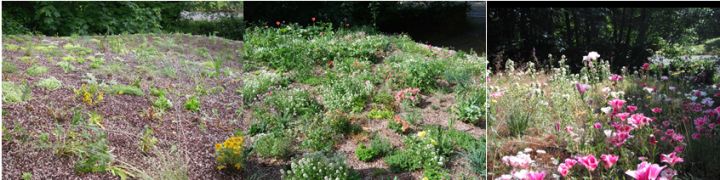
Feature Photograph: My Living Roof in 2006, newly planted; then in 2008 and 2012. (It looks very different at different times of the year–different flowers blooming from early spring and throughout the summer!)

         My Living Roof –plant species list (Phase 1-west side)

Plants:

Yarrow                                                   Achillea millefolium

Nodding Onion                                     Allium cernuum

Chives                                                    Allium schoenoprasum

Pearly Everlasting                                Anaphalis margaritacea

Snapdragons*                                      Antirrhinum majus

Sea Thrift                                              Armeria maritima

Red Paintbrush                                    Castilleja miniata

Large-flowered Collomia                   Collomia grandiflora

Tufted Hairgrass                                  Deschampsia cespitosa

Showy Fleabane                                  Erigeron speciosus

Oregon Sunshine                                  Eriophyllum lanatum

Roemer’s Fescue                                 Festuca idahoensis ‘Roemeri’

Beach Strawberry                                                Fragaria chiloensis

Blanket Flower*                                  Gaillardia x grandiflora

Common Flax*                                   Linum usitatissimum

Spring Gold                                           Lomatium utriculatum

Lupines                                                  Lupinus sp.

Grape Hyacinth*                                 Muscari armenicum

Sea Blush                                              Plectritis congesta

Silverweed                                             Potentilla anserina

London Pride Saxifrage*                   Saxifraga x urbium

Different colored sedum varieties*  Sedum sp.

Hens and Chicks*                               Sempervivum tectorum

Lime Thyme*                                      Thymus x citiodorus ‘Lime’

Sticky False Asphodel                        Tofieldia glutinosa

& misc. bulbs* from a friends yard!

Seeds** direct sown:

English Daisy*                                     Bellis perennis

Godetia                                                  Clarkia amoena

California Poppy                                 Eschscholzia californica

Western Blue Flax                               Linum lewisii

Sweet Alyssum*                                  Lobularia maritima

California Desert Bluebells                Phacelia campanularia

Poppies*                                                Papaver sp.

Violets*                                                 Viola sp.

Recent Entries »