Archive for 4) Ecological Garden Designs

Fruits are made to be eaten!


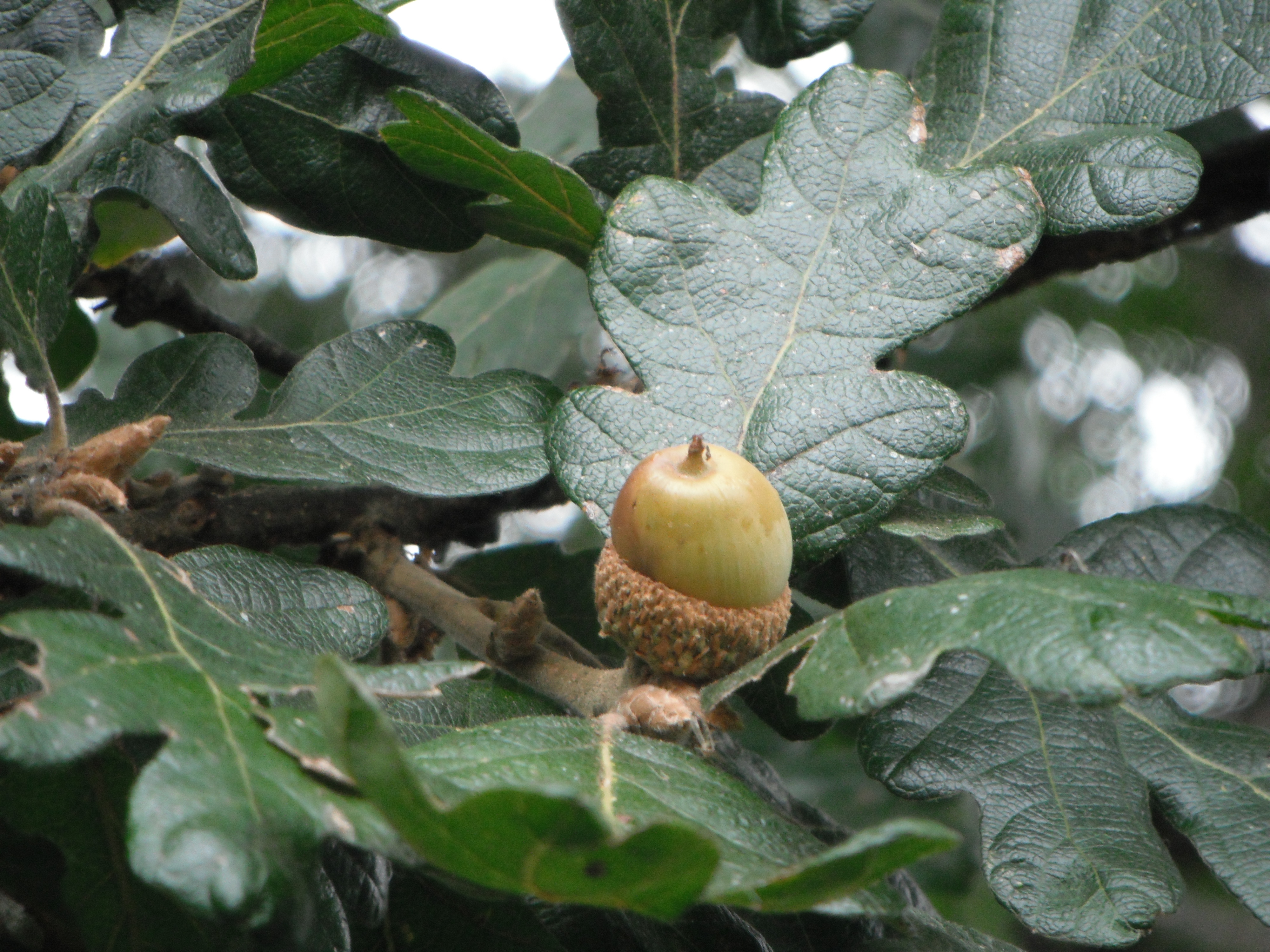
Acorns are nutritious food for squirrels & jays.

Acorns are nutritious food for squirrels & jays.

     Fruits evolved to offer animals a nutritious food, encouraging them to disperse the seeds of the plant.  Frugivores can be free of guilt—fruit is produced to be eaten!   You can be sure that a fruit will attract some kind of hungry animal just as a showy flower will attract a pollinator.  In fact many seeds must pass through the gut of an animal before they will germinate.

    Two of the top wildlife plants are oaks and pines.  Instead of fruit, these trees produce large, nutritious seeds.  It may seem strange that a tree could sacrifice so many of its seeds and still reproduce.  But by strategically producing bumper crops in some years and very little in others, the trees provide an erratic food supply to limit the population growth of the seedeaters.  Birds, squirrels and other small rodents disperse the seeds by caching them for later use.  Forgotten seeds may sprout and grow into new trees.
Blue Elderberry

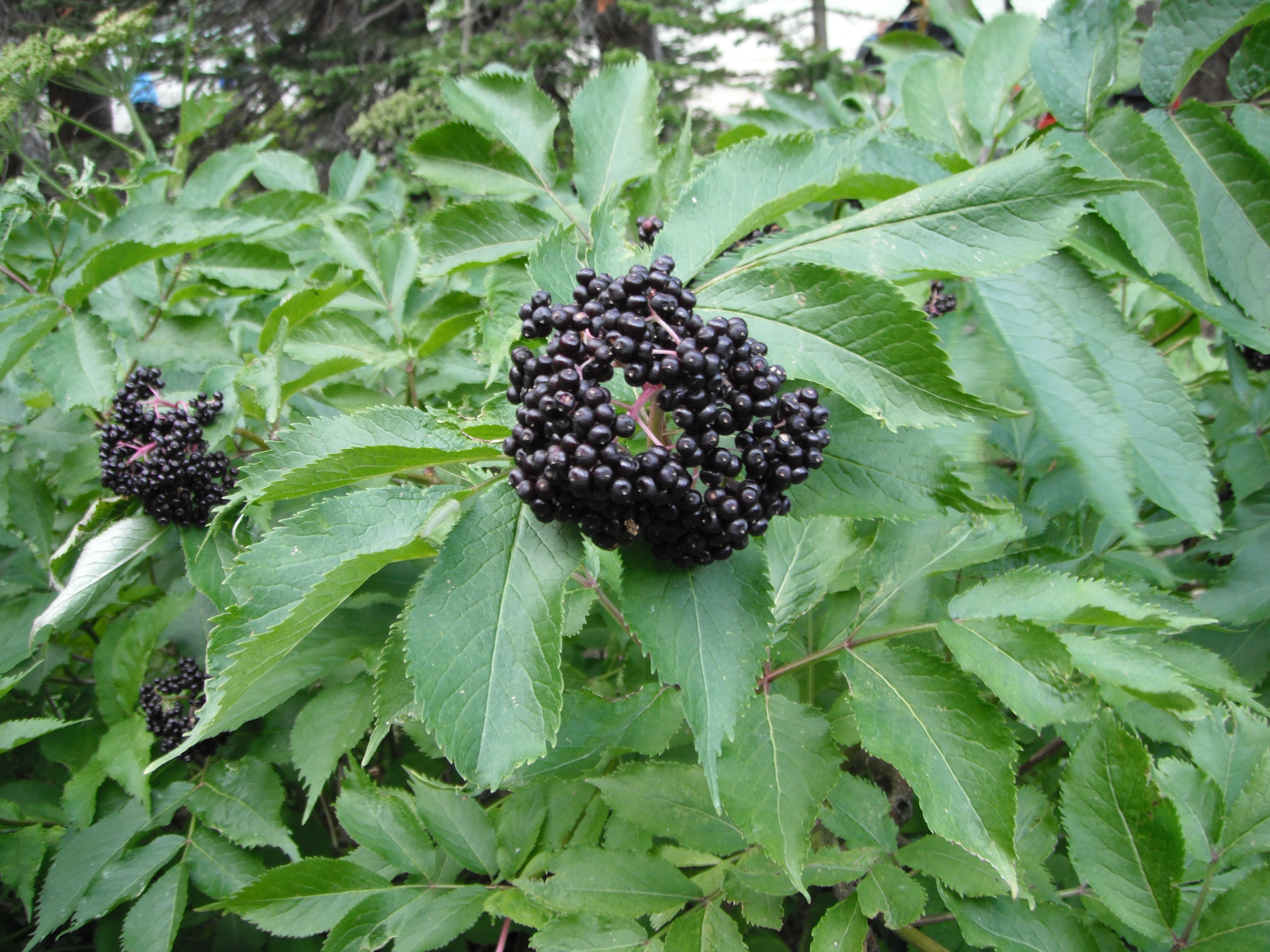
Blue Elderberry

    Elderberries are next in importance.  Red Elderberry, Sambucus racemosa, is the most common in our area.  Blue Elderberry, S. caerulea, can also be found in more open sites.  Pileated Woodpeckers, Flickers, Steller’s Jays and many other birds eat these berries.  People eat them too, usually cooked or made into jelly or wine.  Raw Red Elderberries may cause nausea in people.

    Surprisingly, Poison Oak, Toxicodendron diversilobum, is listed as the next important species. Wren Tits, Thrushes, Flickers, Sapsuckers and other Woodpeckers eat its white berries.  The only places I have seen Poison Oak is on Cutt’s Island and Maury Island.  There is a saying: “Leaves of three, let it be; berries white, poisonous sight.”  Most people would not want this in their yard even with its high wildlife value!
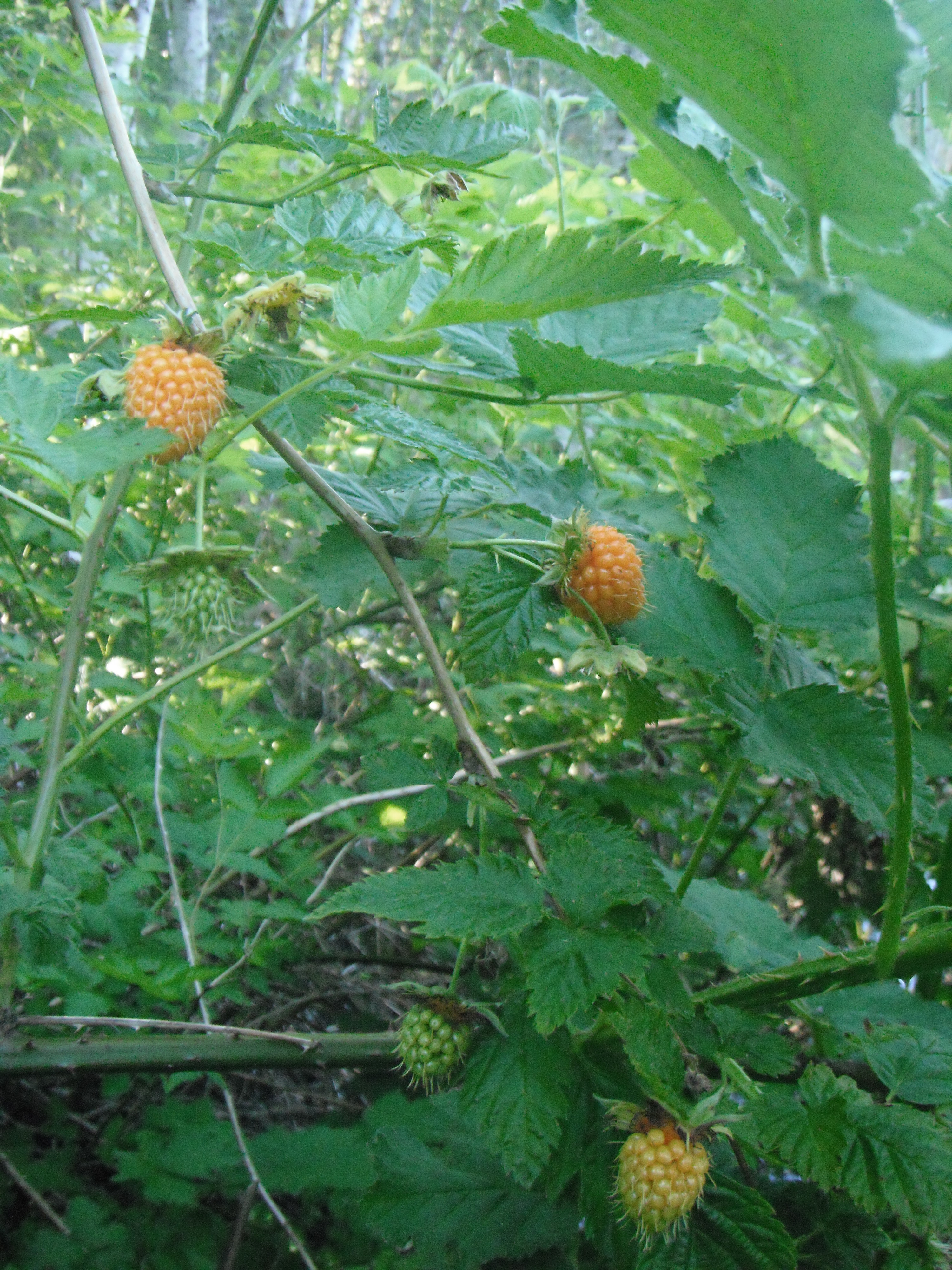
Salmonberries

Salmonberries

    The most important native Brambles, for people and wildlife are Salmonberry, Rubus spectabilis, Blackcap Raspberry, R. leucodermis, and Thimbleberry, R. parviflorus.  Many birds eat these berries, including Robins, Thrushes, Towhees, Tanagers, Grosbeaks, Waxwings and Grouse.  Trailing Blackberry (Dewberry), R. ursinus is our only native blackberry; it often appears as a weed, but you may want to allow some of it to grow in a wild garden.  Himalayan and Evergreen Blackberries, although good for wildlife, are invasive non-natives and should be controlled.

    Many of our important berries are in the Heath family, Ericaceae. The most common are Salal, Gaultheria shallon and Evergreen Huckleberry, Vaccinium ovatum.   People and wildlife enjoy these and other huckleberries, including Red Huckleberry, V. parvifolium.  Manzanitas, Arctostaphylos sp., are more important in California, but we have two native species:  Kinnikinnick or Bearberry, A. uva-ursi, a popular groundcover, and Hairy Manzanita, A. columbiana.  Our only broad-leaved evergreen tree, the Pacific Madrone, Arbutus menziesii has red berries.  
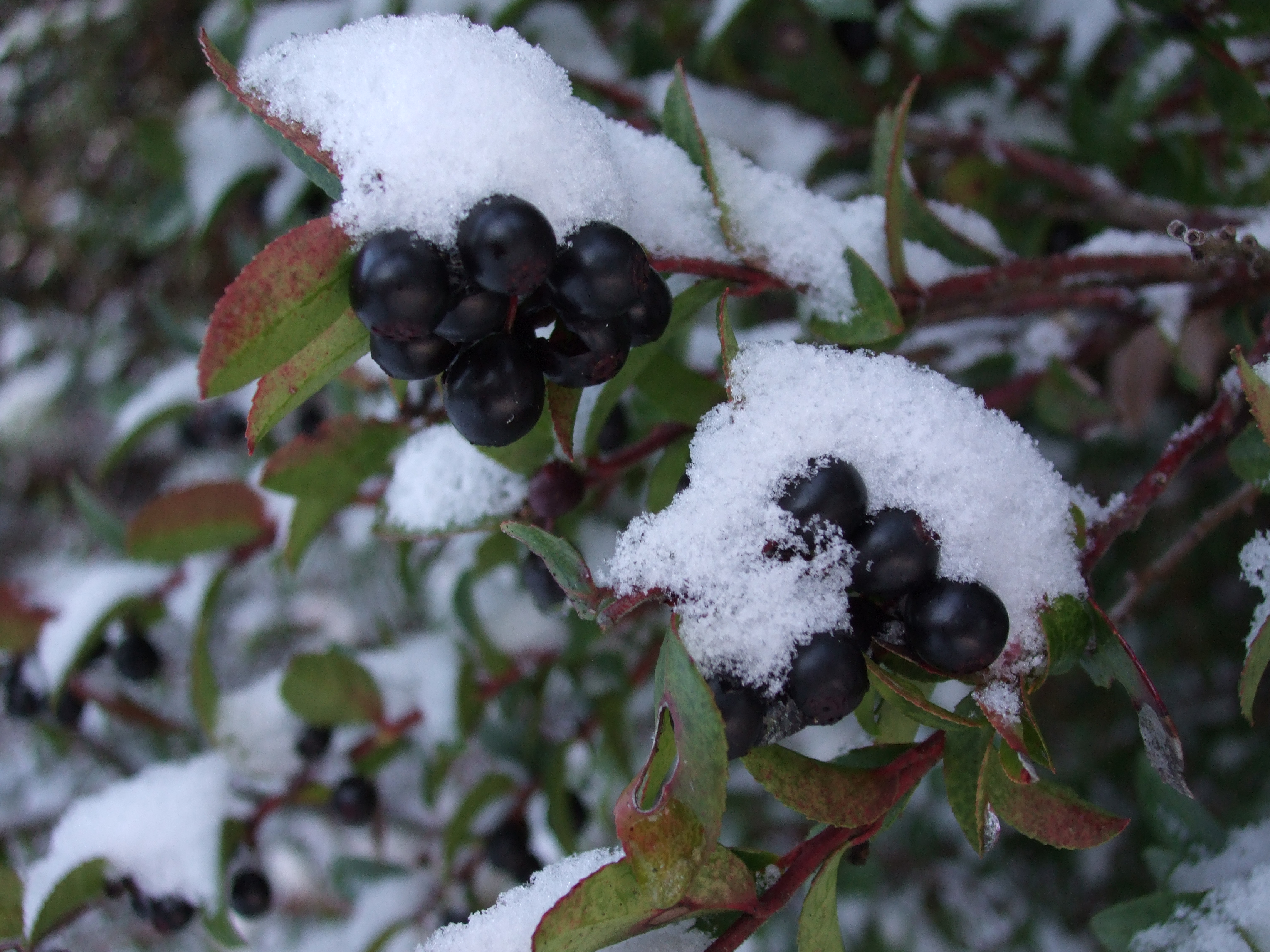
Evergreen Huckleberry

Evergreen Huckleberry

    We have 3 species of Dogwood: a tree; Pacific Dogwood, Cornus nuttallii, a shrub; Redtwig Dogwood, C. sericea, and a groundcover; Bunchberry C. canadensis.  Grosbeaks, Waxwings and Woodpeckers eat dogwood fruits.

    Other fruiting natives include: Cascara, Rhamnus purshiana, Serviceberry, Amelanchier alnifolia, Gooseberries and Currants, Ribes sp., Oregon Grapes, Mahonia sp., Pacific Crabapple, Malus fusca, Black Hawthorn. Crataegus douglasii, Highbush Cranberries, Viburnum sp., Roses, Rosa sp., Honeysuckles, Lonicera sp. Mountain Ashes, Sorbus sp., Indian Plum, Oemleria cerasiformis, and Snowberry, Symphoricarpos albus.  Of these, Serviceberries, Gooseberries and Oregon Grapes are frequently eaten by people; often prepared into jellies.

    In addition to providing food for wildlife and people, berries are often an attractive feature in the landscape during fall and winter, especially the ones with bright red berries.  Treat yourself and the local wildlife to a smorgasbord by planting some of these juicy selections.
Food Forests for the Future

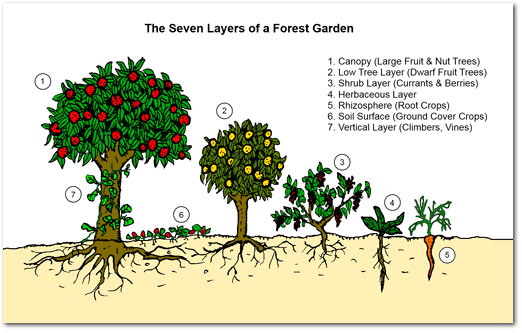
    Being an environmentalist and a native plant horticulturist/botanist, I encourage the planting of native plants to help restore and preserve the natural ecology of our beautiful Pacific Northwest.  However, we must also balance the needs of people with the needs of wildlife.  Food is a basic need of both. That is why I often recommend planting cultivated varieties of food plants as well as native species.food_forest_layers

The above graphic is from permaculturenews.org.

   A Food Forest, aka permaculture forest garden, is a planted garden or arboretum that mimics a woodland ecosystem but uses plants that produce edible fruits, nuts and vegetables. Fruit and nut trees are the upper level, while below are berry shrubs, and edible perennials and annuals. They are planted together instead of separating the trees into orchards and the berry bushes and vegetables into fields of single-species monocultures.  Beneficial plants attract insects for natural pest management and enrich the soil by fixing nitrogen and adding mulch.  “Together they create relationships to form a forest garden ecosystem able to produce high yields of food with less maintenance.” Another benefit of this type of gardening is that because of the diversity, it is not a disaster when 1 or 2 crops fail, whether because of weather, pest problems, or other reasons. The challenge, as in any garden landscape, is getting the “right plant in the right place,” with the appropriate amount of sunlight and water.

   Historical hunter/gatherer societies depended on nuts, fruits, grains, and vegetables that women gathered. Their diet was supplemented by the meat that hunters brought home (once or twice a week, if they were lucky). With the advent of agriculture, people worked together to grow and preserve the food they needed.  

   Currently, many Americans are afflicted with diabetes, obesity and other diet-related health problems. We have an abundance of cheap, high-carb foods, with the added fat & sugar we crave along with chemical preservatives and color, flavor and texture enhancers. We are often duped by the latest diet fad or get contradictory information from doctors, nutritionists & the media.  Although it is easier to buy packaged food off the grocery store shelf, eating less-processed, natural whole foods will likely be healthier for you and your family.  You could even try home canning and preserving.

   Nut trees and some fruit trees, however, because of their ultimate size are not well suited for backyard gardens.  When I worked at Tacoma’s Wright Park, there were a couple of huge chestnut trees. Chestnuts are gathered by searching amongst the prickly husks that have fallen to the ground. It was often difficult to find nice, big nuts because people and squirrels were both competing for them. One local resident told me he would see people with flashlights searching at 1 or 2 in the morning looking for recently fallen nuts. The Black Walnut tree across the street was also popular with the squirrels. Fruit & nut harvesting could be another enjoyable recreational opportunity at local parks if appropriate tree species were planted. Hunting for and collecting natural foods can be fun for the whole family.

   The Beacon Hill neighborhood in Seattle just broke ground on the “Beacon Food Forest” at Jefferson Park. A community urban farming project, it will include a traditional “Pea Patch” along with an Edible Arboretum, Nut Grove & Berry Patch. Neighborhood members will be able to harvest and preserve food for themselves and their families.  I wish the Beacon Food Forest success and hope that they are able to equitably divvy up the harvest and will inspire other communities to create their own “Food Forests.”

(This article was first published in the Peninsula Gateway on November 7, 2012)

Ethnobotanical Garden; People, plants and plant products


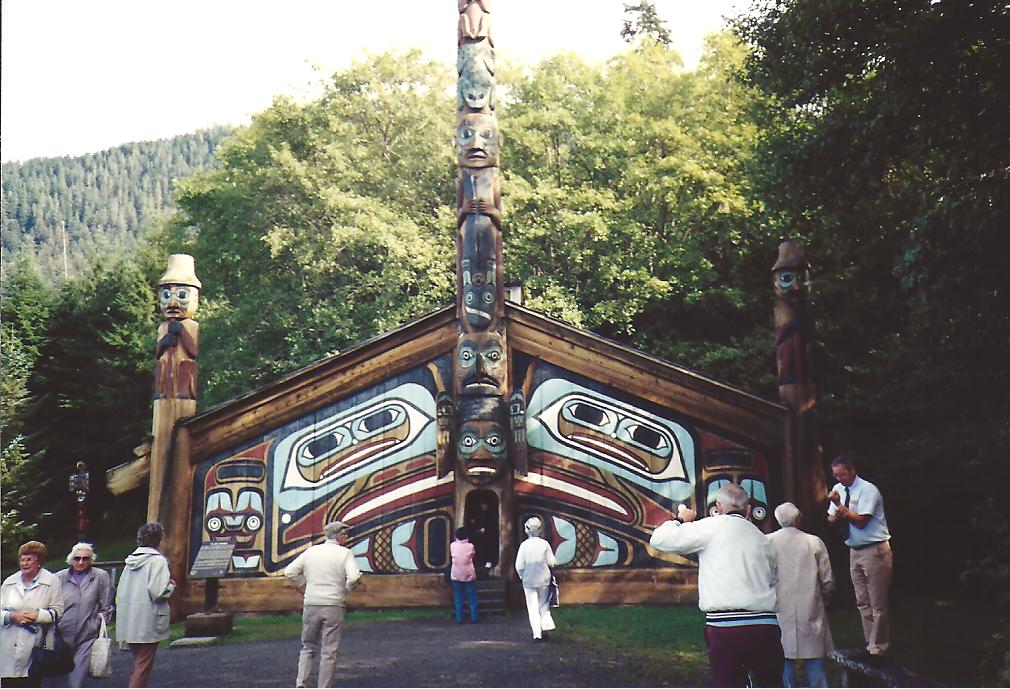
A Cedar Longhouse in Ketchikan, Alaska

A Cedar Longhouse in Ketchikan, Alaska

    People rely on plants for many things.  We use them for food, building materials, medicine, clothing, dye, cosmetics, in rituals, and more.  Ethnobotany is a branch of anthropology that studies the use of plants by native peoples.     Unfortunately, historically, western civilization has horribly mistreated many herbalists, usually women, who used their knowledge to benefit their community.  Due to their position of respect and power, they were often looked upon with suspicion by church leaders and branded as witches. Conquering armies and colonists also had little respect for the knowledge of “primitive” native peoples.

   Erna Gunther’s “Ethnobotany of Western Washington” was the first and is still an often used resource on the use of plants by Pacific Northwest natives.  In the 1930’s, she interviewed both women and men. Women knew the food and medicinal plants; men knew the materials in nets, fishing gear, and woodworking.  Another good resource today is the University of Michigan database of Native American Ethnobotany.

   The northwest could be called the “berry capital of the world,” due to the preponderance of berry bushes.  Native peoples ate berries fresh, dried like raisins, cooked, mashed and dried into cakes, or preserved in fats such as oolichan grease extracted from a small fish. The most important berries for eating were Salmonberry, Salal, huckleberries, Thimbleberry, Oregon Grape, Serviceberry, elderberries, and strawberries.

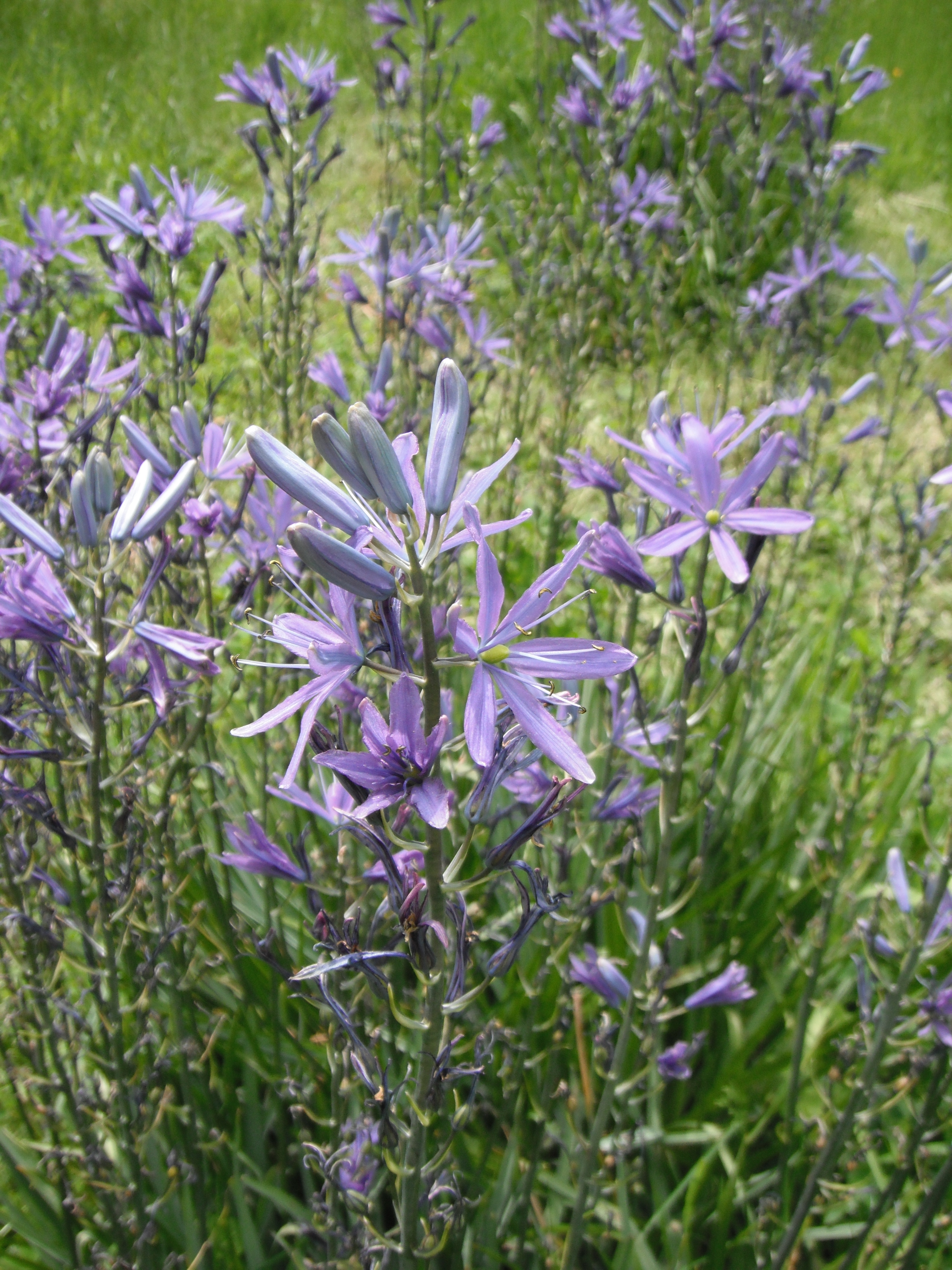
Camas Flowers

Camas Flowers

   Bulbs and roots were also important foods; the most important was camas.  Except for Salmon, no article of food was more widely traded.  Bulbs were dug in the late spring and cooked in a pit, sometimes dried after cooking and cached in baskets in trees.  Undercooked camas causes severe gas & flatulence, as members of the Lewis & Clark party painfully discovered; cooking breaks down the complex sugar, inulin, to fructose. The roots of Wapato was also cooked, dried, and eaten with fish.

   Western Hazelnuts were readily available if a person could beat the squirrels to them. Native people that lived near Oregon White Oaks would soak acorns to leach out the tannins or they would bury them in baskets over the winter and eat them in the spring.

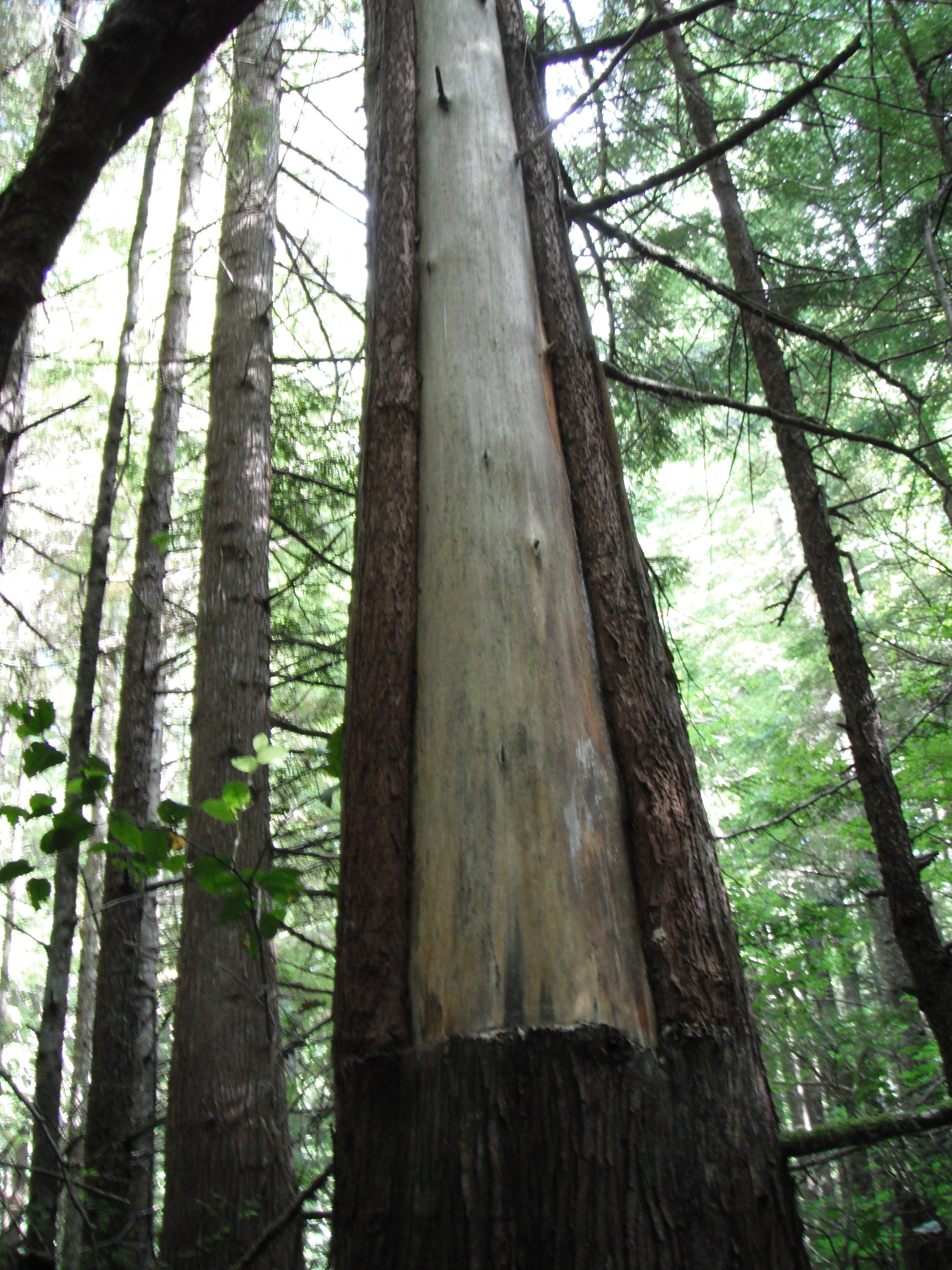
A "Culturally-modified" Cedar along the trail to Shi Shi Beach on the Makah Indian Reservation

A “Culturally-modified” Cedar along the trail to Shi Shi Beach on the Makah Indian Reservation

  The most important tree for native people was the Western Red Cedar, also known as Giant Arborvitae or “tree of life.” The wood was used for building long houses, totem poles, canoes, cradles, etc. The bark was made into clothing, mats, diapers, etc.  Limbs were twisted into rope.  Baskets were made from the roots. Alaska Yellow Cedar was used similarly by natives in BC and Alaska. Douglas Fir, Western Hemlock and alder were also used for making tools and for firewood. Yew wood, prized for its strength and elasticity, was used to make tools and weapons, particularly bows. Oceanspray, known as “Ironwood” in English, was used for tools and utensils; it was made harder by heating it over a fire and polishing it with horsetail stems.


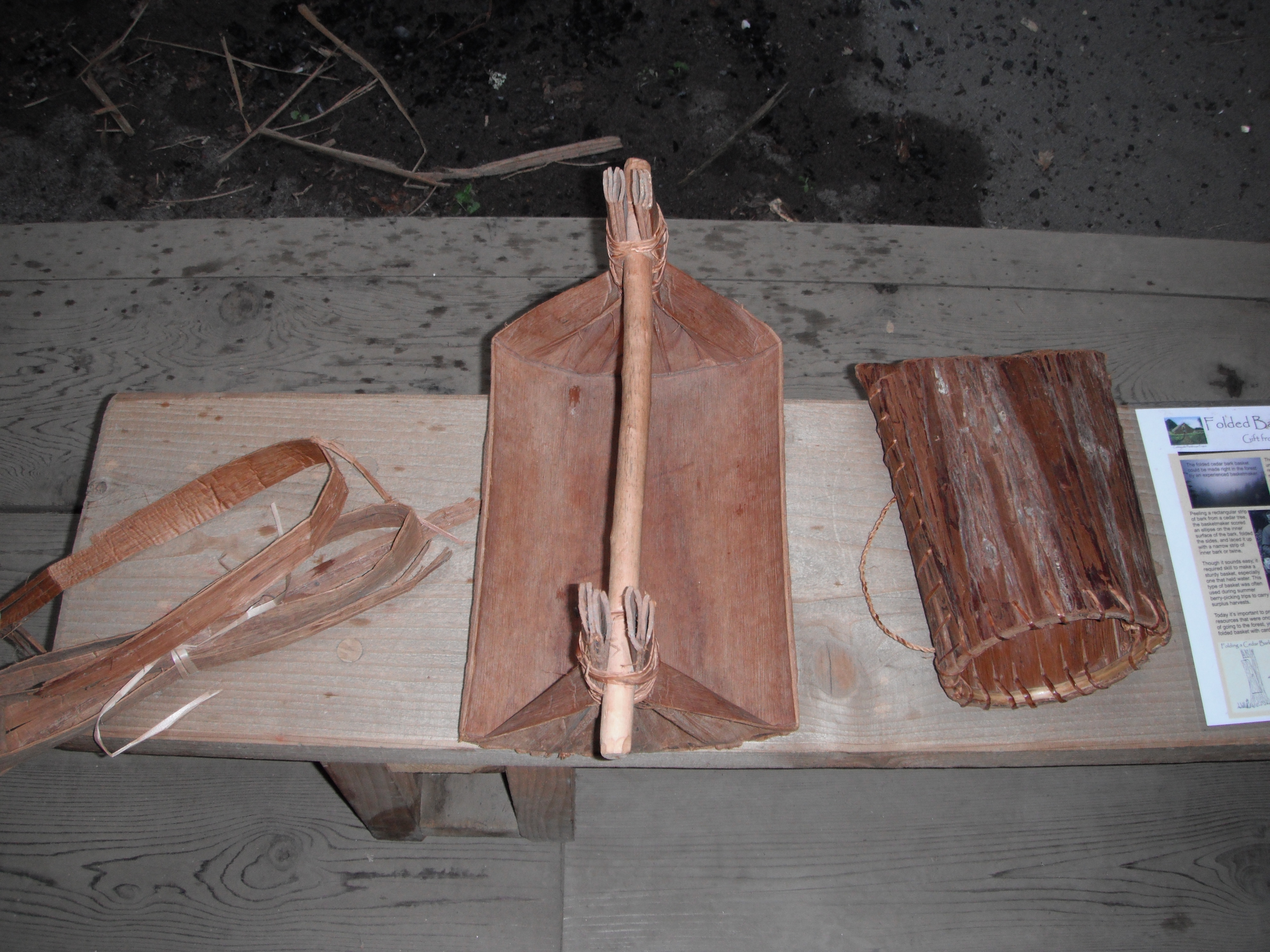
A canoe bailer & berry-picking basket from Ridgefield National Wildlife Refuge's Cathlapotle Plankhouse Interpretive Display

A canoe bailer & berry-picking basket from Ridgefield National Wildlife Refuge’s Cathlapotle Plankhouse Interpretive Display

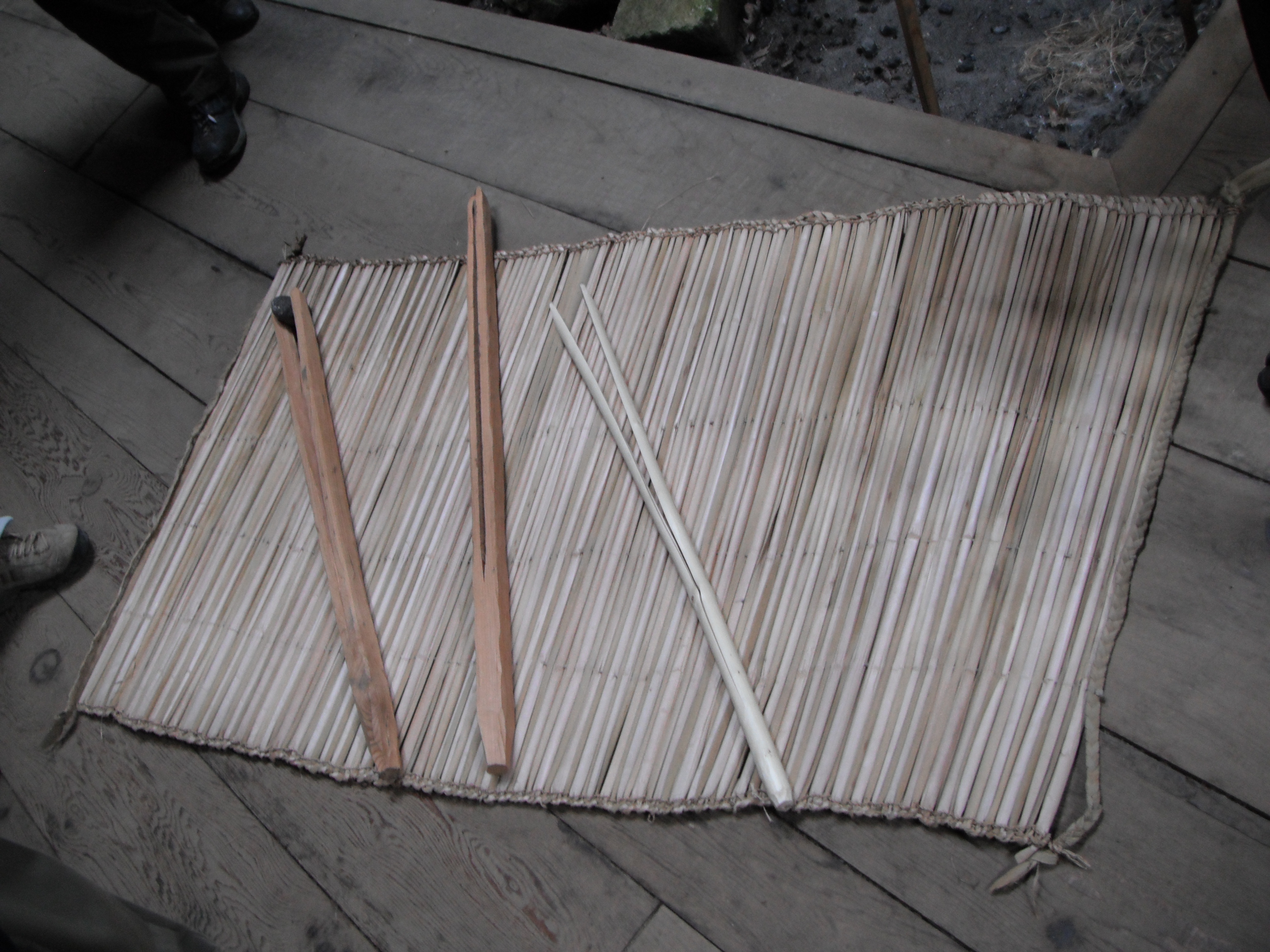
    Many plants were used in basketry and for making mats and rope including Vine Maple, willows, Red-twig Dogwood, Trumpet Honeysuckle, Beargrass, Slough Sedge, Cattails, and Tule or Hard-stemmed Bulrush.  Large leaves such as Thimbleberry, Big-leaf Maple, and Sword Ferns were used as containers or to line cooking pits or drying trays.

A Tule Mat

A Tule Mat


    Cascara bark has long been known as a laxative, willow bark a pain-reliever. Yarrow and Devil’s club, a relative of Ginseng, were both used for various medicinal purposes.

    It is sad when knowledge of the cultural uses of native plants is lost and not passed on to younger generations—we need to thank ethnobotanists for preserving a treasure trove of historical plant knowledge and lore.

(This article was first published in the Peninsula Gateway on June 6, 2012) 

Guerrilla Gardening and Community Garden Projects, it’s Bewildering!

    We’ve all walked or driven by neglected areas overgrown with weeds and littered with trash.  Guerrilla Gardening, (AKA bewildering) is a term used for the unauthorized cultivation of plants or crops on vacant land. The goal is to beautify neglected areas and create oases of greenery within an otherwise ugly asphalt and concrete jungle.  Today, there is even a faction involved in the Occupy Wall Street movement that is attempting to teach people to “Sow Seeds, not Greed.”

    Although Guerrilla Gardening seems like a benign crime, it may be best to get permission from the landowner before carrying out a mission.  The same M.O. can be used for community garden or senior projects:

1)      Spot some local uncared for land.  You can find them along sidewalks, between buildings, on road medians and more.

2)      Decide whether the plot will need some preparation before planting. Will you need to remove weeds or trash? Will the soil need amendments?  If there is no unpaved ground, perhaps you could plant up some containers.

3)      Plan a mission.  Arrange a day and time to do the work, who will assist you, and what you will need.

4)      Determine what plants and/or design to use in your garden.  Your choices will have a huge effect on its success or failure.  Select impactful plants that will be beautiful throughout much of the year.  A few annuals are okay for instant color, but perennials will endure. Choose appropriate plants for the light, moisture, and soil conditions. Select hardy, drought-tolerant plants that can thrive with intermittent care. Native plants are ideal because they are adapted to the local climate and enhance habitat for butterflies, birds, and other native wildlife species. Or, perhaps the community would benefit from food plants; fruit trees and/or berry bushes.

5)      Arrange transportation – You need to get everything to and from the site.

6)      Gather your materials: a) Trash bags or containers to remove trash and weeds from the site. b) Enough plants to fill in your plot. You can buy plants from stores, divide & collect from other sites, or start seeds at home.   Well-rooted plants have the best chance of survival.  Willows and Red-twig Dogwoods, however, can be planted as live stakes, cuttings of branches stuck directly in the ground. c) Tools – gloves, rototiller, wheelbarrows, hoes, shovels, rakes, etc.  d) Soil amendments, fertilizer & mulches. Organic matter, such as compost, is almost always beneficial.  Organic, slow-release fertilizers are best.  Shrubs and trees benefit from mulching after planting. e) Water – Newly planted plants always need to be watered in, unless the weather is cool and rain is imminent. d) Signs to tell about the project and the plants.

7)      Planting Day! Clear the land of weeds and trash. Prepare the soil for planting. Plant, fertilize water your plants. Clean the area before leaving. Leave signs or plaques to tell about the project and to encourage others in the community to help.

8)      Maintain (water & weed) your garden or get a local volunteer to care for the plot. The biggest cause of failure is inadequate irrigation.

    If you don’t have the time, money, or energy to do a complete garden makeover, seedbombs are an economical alternative.  Made from a mixture of clay, compost, and wildflower seeds, they are designed to be thrown into abandoned sites.  Or, better yet, just scatter some seeds—Just make sure you get a mix of native wildflowers seeds that does not contain noxious weeds.

    Just a few colorful, cheery flowers enhance habitats for people and wildlife!


Mosses in the garden; good or bad?


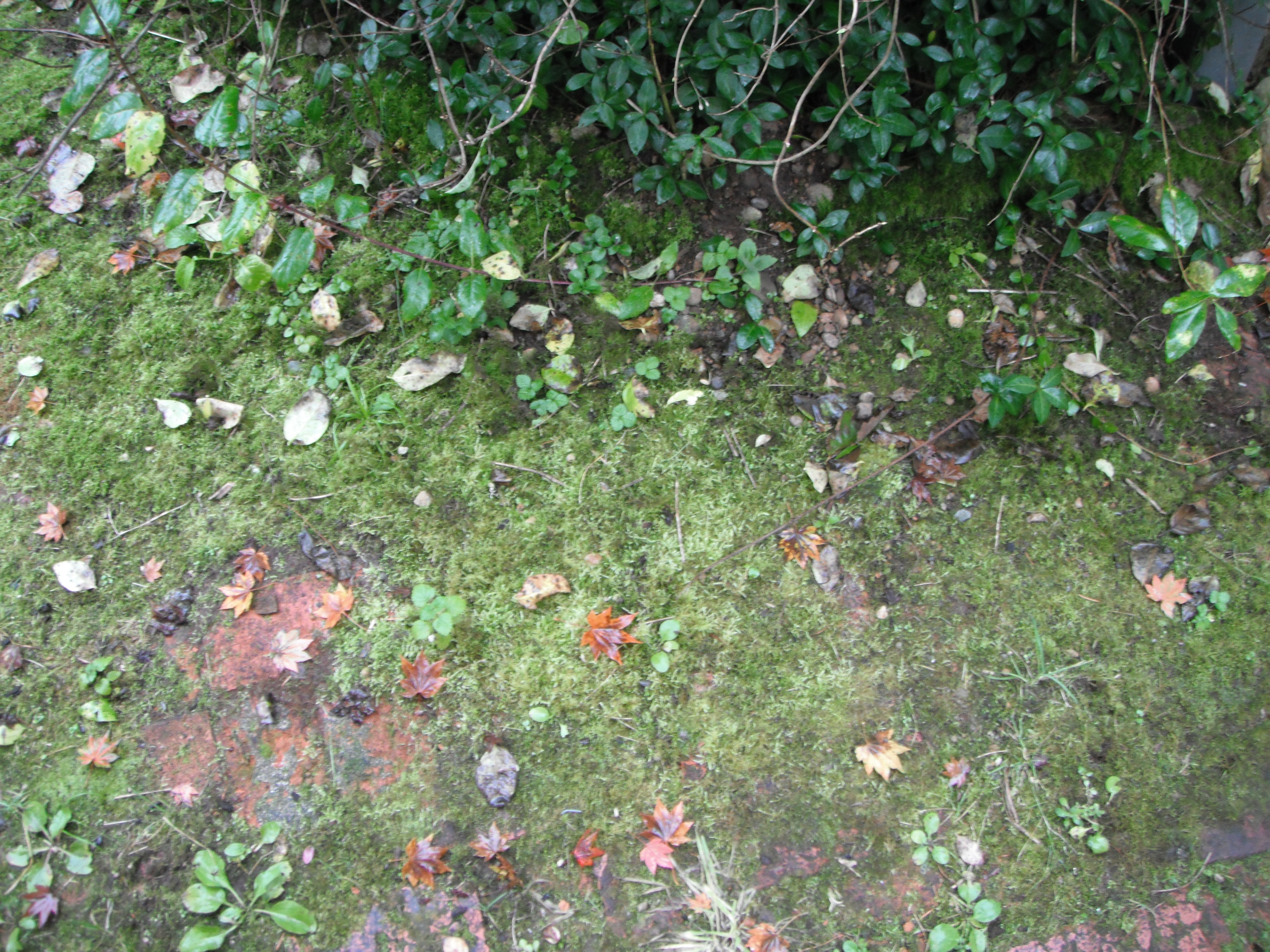
Moss growing on my brick patio.

Moss growing on my brick patio.

   There are many moss-like plants.   Sea Moss is actually algae; Reindeer Mosses are lichens; Clubmosses (Lycopodiums and Selaginellas) are vascular plants more closely allied with Horsetails; Spanish Moss is a bromeliad (related to Pineapples); Irish and Scotch Moss are in the carnation family.

     True mosses, in the class Musci; include “true” mosses, peat mosses, and granite mosses.    They are primitive “non-vascular plants,” meaning that they have no tissues for conducting water or nutrients such as the xylem or phloem in “higher” plants.

    Plants that have no vascular tissue cannot grow large.  They need to absorb moisture and nutrients from their surroundings.  Because of this, like lichens, mosses are very susceptible to air pollution.  They need to live in moist places during part of their life cycle.  Mosses may be found on the ground, on rocks and cliff faces, near waterfalls, on rotting logs, and in bogs.  Mosses or other plants that grow on trees are called epiphytes.  There are about 700 species of “true mosses” and about 40 species of Sphagnum peat moss in our region.

    Do you consider moss a pest?  It may be–when it is growing on your roof–Just make sure that you use an environmentally-friendly, “least toxic,” product when controlling moss on structures. 

    Many people in their quest for a perfect lawn will use chemicals to kill moss.  Proper management is a better strategy–Rake the lawn to remove thatch and moss, aerate it to make sure it drains freely and overseed to fill in bare spots.  Irrigate adequately during dry periods to keep the grass healthy but do not let water puddle, follow a recommended fertilizer program, apply lime to keep the pH between 6.0-6.5, and mow grass at the proper height for the species.   In shady areas, turfgrass grows poorly; other groundcovers may be more suitable—mosses, at least, are green! 

    A Moss Garden can be an attractive feature in a woodland garden.  I saw a You-tube video that made it sound easy—all you had to do was acidify the soil!  Mosses grow best at a pH of ~5.5.  To try to encourage more moss, I tried a little experiment in my yard.  After testing the pH of my soil, I endeavored to lower the pH a little more.  The only products readily available for acidifying soil are aluminum sulfate (usually sold for making hydrangeas bluer), and elemental sulfur (often sold for treating fungal diseases).  It was difficult to quantify the results.  The amount of mosses varies dramatically through the seasons and unfortunately, the grass still survived.  The plots treated with the aluminum sulfate, however, appeared to have a little more moss.

    For the best success, you really should start with bare ground in a shady location, removing all the grass, weeds, leaves and debris.   Next, scratch up the soil to loosen it slightly and moisten the soil.  There are two methods for establishing moss in a new area.  You can transplant entire clumps of moss to the new spot or make a “moss milkshake” to spread over a larger area by mixing clumps of moss with buttermilk or beer in a blender (using a few types of moss insures a better success rate).  Just make sure to mist or water regularly and remove any leaves or debris that fall on the moss.  These methods also work well for establishing moss on rocks, in between pavers, in bonsai, fairy gardens, or other special container gardens.

    A Moss Garden is a great project for an environmentalist on St. Patrick’s Day!  After all, is anything greener than moss?

(This article was first published in the Peninsula Gateway on March 16, 2011)

Grow California natives to prepare for Global Warming


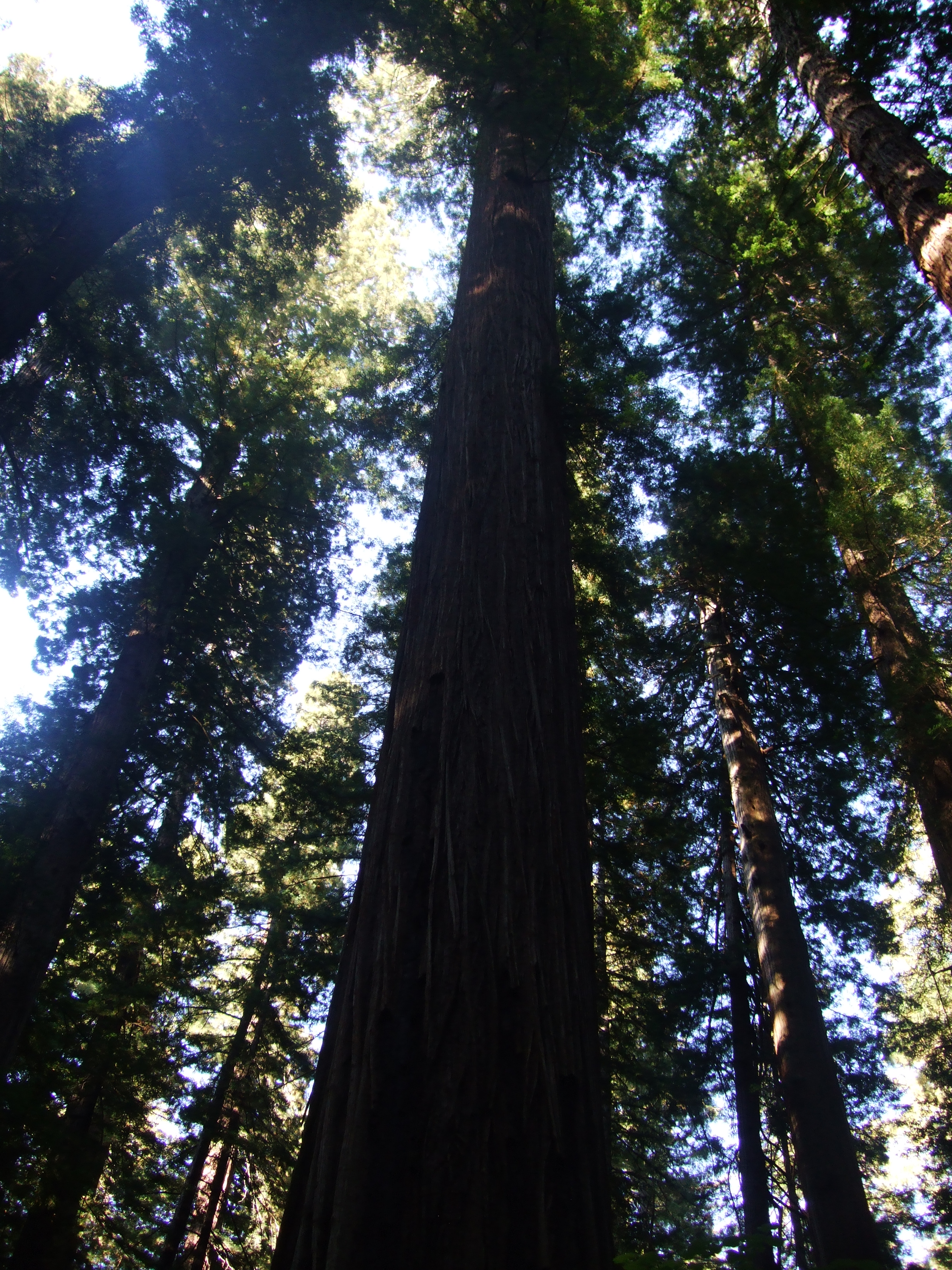
Redwoods are the world's tallest trees. They live in the coastal "fog belts."

Redwoods are the world’s tallest trees. They live in the coastal “fog belts.”

    We share many of our Washington native plants with British Columbia and Alaska, and/or Oregon and California.  The ranges of some species extend to the Rocky Mountains; others reach across North America to the east coast.   A few are circumpolar, found throughout the northern latitudes of Europe and Asia, too.  Historical distribution, geographic features, climate, and competition all influence the current distribution of species.

    Fossil evidence indicates that 50 million years ago the climate of the Pacific Northwest was warmer, much like the tropics of today.  15,000 years ago, there were huge floods as ice age glaciers melted.  Changes in the earth’s climate directly influence the number and distribution of species.  There have been many extinction events in the past 4.5 billion years; there will be more in the future.

     Global warming is a concern due to its potential impact on human populations and the agricultural crops and livestock on which we depend upon for survival.  No one can predict the ultimate consequences of climate change, but we should try to make smart choices regarding food security and limiting population growth.   Hopefully, our children, grandchildren, and future generations will not have to fight, tooth and claw, for limited resources.  – And be able to experience the beauty of the natural world–however changed it might be.

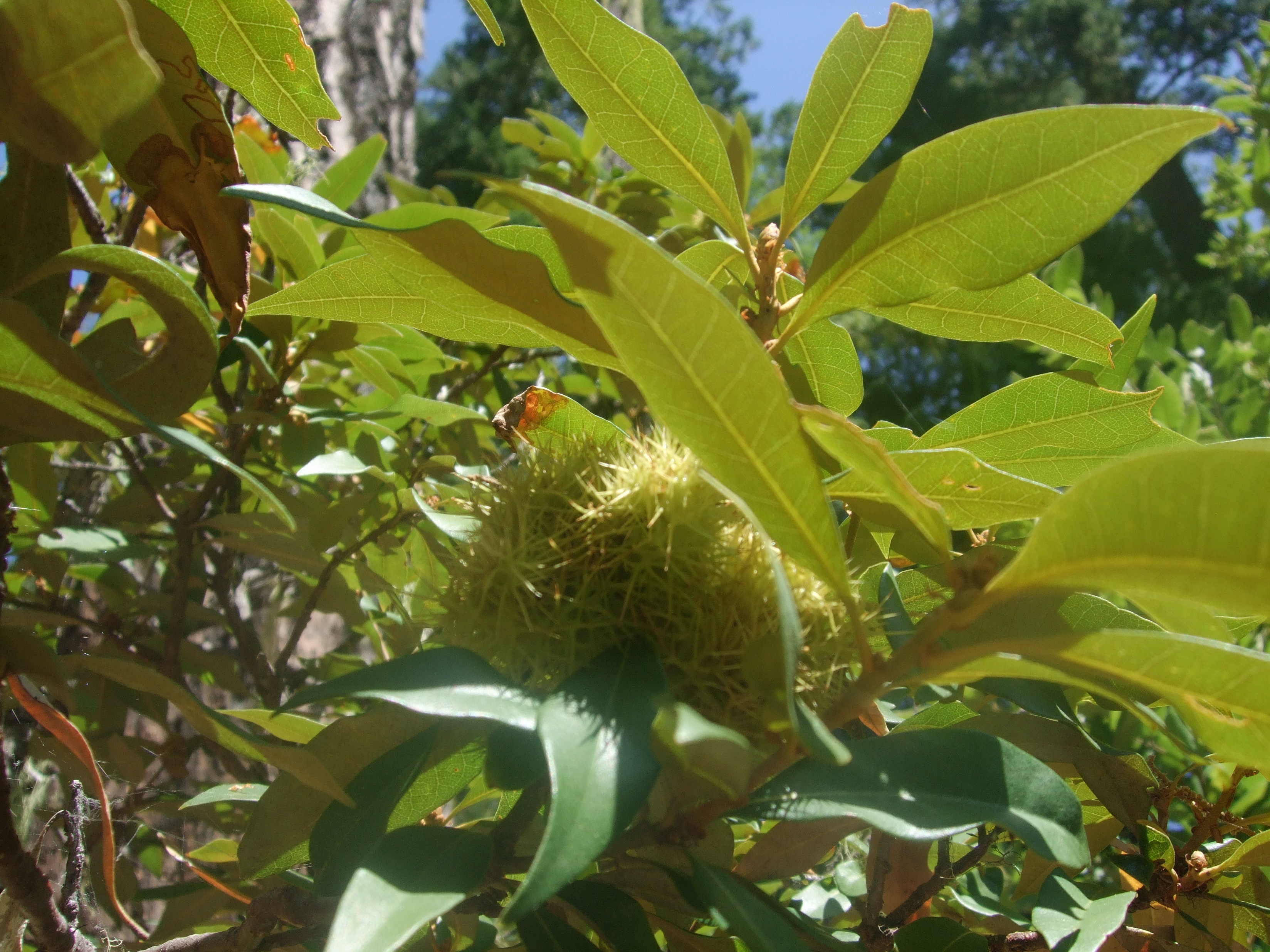
Golden Chinkapin, Chrysolepis chrysophylla

Golden Chinkapin, Chrysolepis chrysophylla

    By planting a diversity of landscape plants, including those tolerant of warmer temperatures, such as California species, you may be creating a habitat that could be a refuge for many wildlife species so that they can survive climate change, too.

   Coast Redwood, Sequoia sempervirens, and Giant Sequoia, Sequoiadendron gigantea, both grow well here in the northwest.    Incense Cedar, Calocedrus decurrens, looks a lot like our Western Red Cedar, but with coarser branchlets and a narrower crown.  California Nutmeg, Torreya californica, is a slow-growing conifer related to the yew with longer needles and a greenish to purple fruit.

    There are many California oaks, Quercus sp., both trees and shrubs, including the “live oaks” (evergreen oaks).  A related tree is the Tanbark Oak, Lithocarpus densiflorus; it has leathery leaves and acorns.  The Golden Chinquapin, Chrysolepis chrysophylla, is an evergreen tree related to chestnuts.

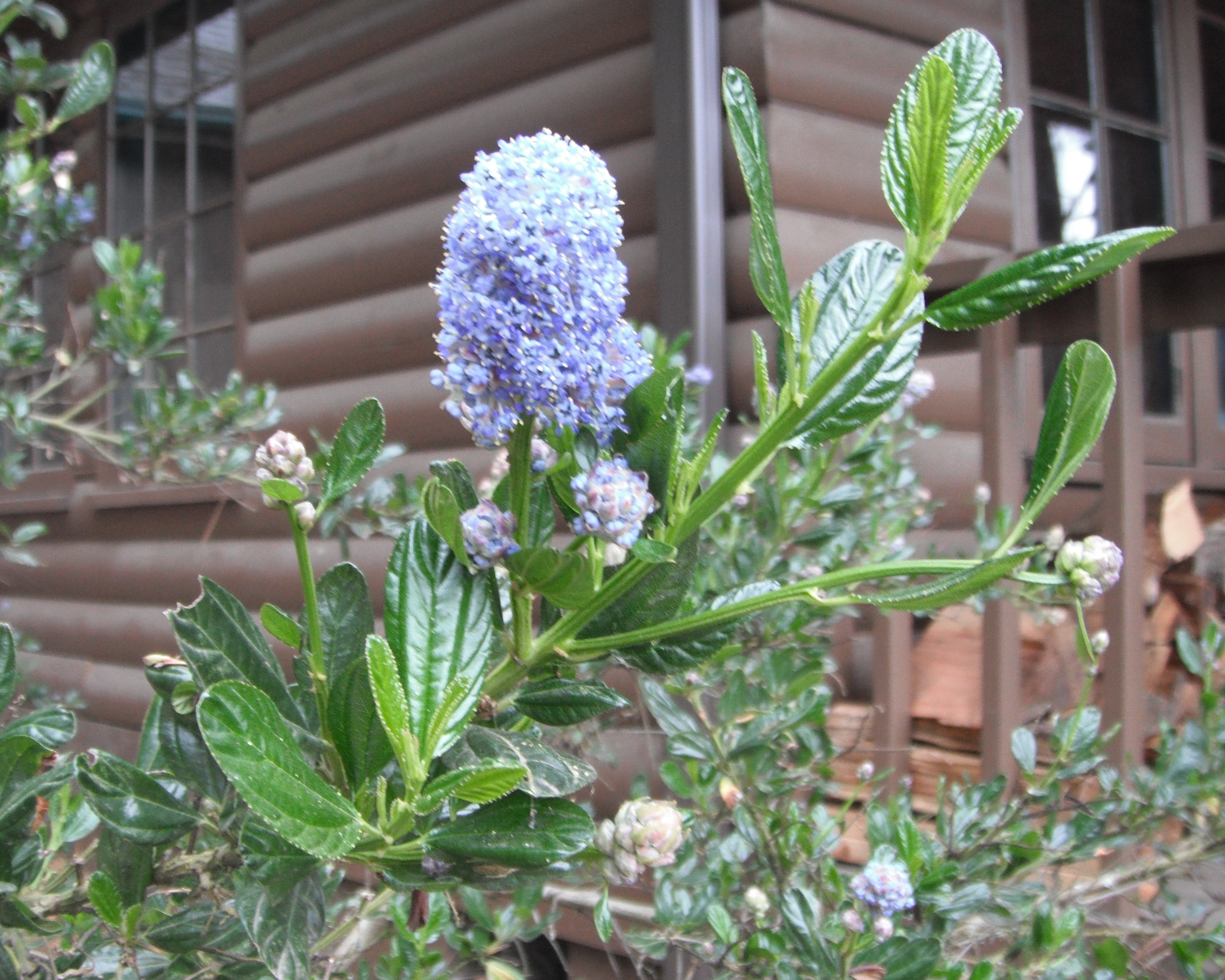
Wild Lilac or Blueblossom, Ceanothus thysiflorus

Wild Lilac or Blueblossom, Ceanothus thysiflorus

   The California Bay Laurel, Umbellularia californica, also known as Oregon Myrtle, is a tall evergreen tree with fragrant, lance-shaped leaves and wood used for carving.  –Not to be confused with Pacific Wax Myrtle, Myrica californica, a fragrant evergreen shrub.

    The California Buckeye, Aesculus californica, has fragrant, candelabra-like, cream-colored flower plumes.  The California Sycamore, Platanus racemosa, is a large tree with maple-like leaves, and smooth, twisting branches.  Silktassel, Garrya elliptica, has long greenish-yellow catkins in early spring; male plants have longer, more impressive catkins.

Greenleaf Manzanita, Arctostaphylos patula

Greenleaf Manzanita, Arctostaphylos patula

    California is home to most Manzanitas, Arctostaphylos sp., and Wild Lilacs, Ceanothus sp., both are mostly evergreen.  Manzanita species vary from groundcovers to large shrubs.  All have the characteristic urn-shaped white or pink berries, followed by red or brown berries.  They are well-known for their red to purple peeling bark.   Wild Lilacs also vary from low, spreading species, to upright shrubs.  As the common name implies, most have powder-blue to deep violet-blue flower clusters (some are white).

    Western Azalea, Rhododendron occidentale, has fragrant, white to pink blossoms.  Spicebush, Calycanthus occidentalis, has brownish-red waterlily-like flowers with the fragrance of “an old wine barrel.” Western Redbud, Cercis occidentalis, has small, magenta flowers in early spring, followed by reddish-brown seed pods.

   It may be difficult to find some of these plants—if you get any from Oregon or California, it is important to buy nursery plants that are certified free from “Sudden Oak Death Syndrome.”

(This article was first published in the Peninsula Gateway on June 16, 2010.)

Grow a “Greener” Lawn or “Eco-lawn”

   Not long ago I was at a local hardware store with my husband and a friend, who my husband often helps with home repair & maintenance. The friend wanted my advice on a pesticide for his lawn. My initial response was that since I try to be mostly organic, I am not up to date on pesticides. I, personally, always cringe when I walk down that aisle knowing that many of those chemicals will end up in our streams and in Puget Sound.

   This friend had some brown patches in his lawn and thought he needed something for crane flies. I pondered this for a second then asked him: “How do you know you have crane flies?”  I explained that proper diagnosis is essential before applying any pesticide. Not only is misapplying pesticides bad for the environment, it wastes money. He agreed to have me come back to his house to investigate. I cut out a square of his turf and flipped it over—there was no sign of crane fly larvae or their “leatherjacket” pupae.

   So what was causing the brown spots? He said it always seemed to happen during the hottest part of the summer.  He uses a reel mower and always cuts the grass very short. We keep trying to tell him he needs to “cut it high and leave it lie.”—but his trimmer even at the highest setting only leaves about an inch of the grass blade remaining. That is not much photosynthetic surface for a plant to be able to maintain itself and develop a good root system.  Hot summer days puts the grass under even more stress. We try to convince him to use his rotary mower and let the grass grow higher so it has a chance to develop a better root system. –After more discussion, we also figured that some of the brown spots may be due to frequent visits by their daughter’s dog.

    I further recommended that he scratch up the dead grass and buy some grass seed to sow in the dead areas; but he was worried that the new grass would be a different shade of green.

    Lawns and turf help create great places for playing outdoors and provide a safe place for toddlers to explore. What kid doesn’t love rolling down a grassy hillside? Can you recall the feel of running barefoot in a lush, green lawn? It is estimated, however, that homeowners use 10 times more pesticides per acre than farmers, which is not good for people, pets or wildlife.  Gas-powered lawn equipment adds to air and noise pollution.  An estimated 10,000 gallons of precious water is applied to suburban lawns each year. Lawns also provide little benefit or ecological diversity for local wildlife.

   Fertilizing lawns with natural organic, slow-release fertilizers helps to limit excess nitrogen and phosphorus from leaching into groundwater and avoid algal blooms downstream. Tagro is great for lawns especially after aerating.

An "Eco-lawn" contains shorter, drought-tolerant grasses and wildflowers.

An “Eco-lawn” contains shorter, drought-tolerant grasses and wildflowers.

   Unless you want a play surface, I usually recommend  planting native trees, shrubs and groundcovers and/or a ”food forest” and garden that will provide fresh fruits & vegetables. The aesthetic suburban ideal of a perfectly manicured, weed-free lawn is just not environmentally sustainable. An “eco-lawn” is a good alternative for those who still want a lawn. It is a mixture of shorter, drought-tolerant grasses and flower seed that does not have to be watered, mowed or fertilized as often.

   The Tacoma-Pierce County Health Department has some excellent publications on natural yard care.  Their bulletin Natural Lawn Care discusses grass selection, mowing, fertilizing, watering and more…

(This article was first published in the Peninsula Gateway on September 12, 2012 as “Growing a ‘greener’ lawn doesn’t mean you have to use pesticides.”)


Attract Wildlife with Flowers

     If you’ve ever read a book or magazine article about attracting wildlife to your yard, you probably have seen lists of flowers that attract hummingbirds and lists of flowers that attract butterflies.  I thought it was somewhat ridiculous, however, when one book listed flowers that attract bees!

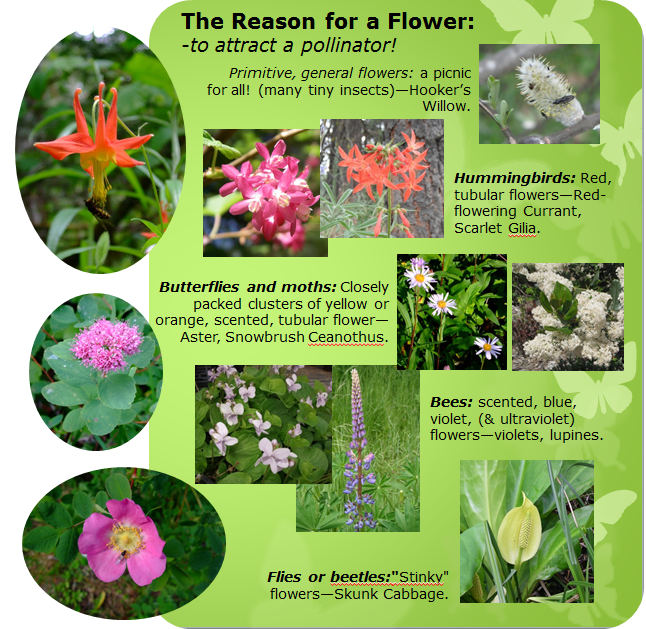
    The reason a plant produces a showy flower, is to attract a pollinator.  If you are attracted to a flower, because of its beauty or its fragrance, it is sure to attract other creatures as well.

reason for a flower   Botanists classify flowers as primitive or specialized.  A primitive flower like a Magnolia can be compared to a community event—everyone is invited to sample the fare.  More specialized flowers have evolved to attract just one particular species of pollinator, that in turn have evolved to be better able to access the nectar or pollen of that flower.  A classic example of this type of coevolution is when Darwin was ridiculed for predicting that there must exist a moth with a 12-inch long tongue to pollinate an orchid that had a 12-inch long nectary.  Over 40 years later that moth was finally discovered in Madagascar where the orchid had originally been collected.   This degree of specialization, however, can ultimately lead to extinction of both species when either of the species is threatened.

    Instead of lists to help you choose flowers to attract wildlife, it is more helpful to know what type of flower attracts what type of pollinator.  The following are “preferences.”  Many different pollinators are likely to visit white flowers or more primitive flowers.

    Hummingbirds prefer red, orange or pink, tubular flowers.  Pollen is transferred when protruding stamens and stigmas brush up against the hovering hummingbird as it sips nectar from the flowers.  The color red is especially attractive to hummingbirds during migration.  I always put out my hummingbird feeders when Red-flowering Currants begin blooming in early spring.  Hummingbirds seek out the brightly colored flowers on their return journey from wintering in southern regions such as Mexico.  Some hummingbirds may stay year-round if the food supply is sufficient.  See my handout: Native Flowers for Attracting Hummingbirds.

    Butterflies and moths prefer yellow or orange, scented, tubular flowers.  They need a landing platform and prefer closely packed clusters of flowers so that they can rest while lapping nectar from several flowers at one stop.  They especially like composites such as asters, daisies and sunflowers that have several florets in one “flower.” See my handout: Native Flowers for Butterflies.

    Bees prefer scented blue and violet flowers.  Some flowers such as pansies and violets have ultraviolet “landing pads” that guide bees in the same way as lights on an airstrip guides airplanes.  Fruit growers often provide “nest boxes” for native Orchard Mason Bees.  These “busy bees,” are smaller than honey bees and are very good at pollinating apples, plums and many other horticultural crops.

    Flies or beetles usually pollinate “Stinky” flowers, such as Skunk Cabbage.   Bat flowers, such as the Saguaro Cactus, are white or cream-colored, fruity-smelling, large and dish-shaped.  In South Africa and Australia rodents pollinate flowers such as Proteas.

     Other insect species also pollinate flowers, but I’ll leave the identification of most to an entomologist.  Flowers provide a convenient food for many insects; that in turn may become food for birds and other animals. The seeds and fruits that develop after pollination are also important foods for animals and people. –So grow and nurture the flowers that make you happy, and you are sure to make some of the local wildlife happy too!

Mary, Mary, Quite Contrary, How Does Your Garden Grow?


My Home Garden

My Home Garden

    In the1880 U.S. Census, the occupations of 41% of the Heads of Households were listed as Farmer, Farm Laborer or Farming.  Of those that had other occupations, you can bet that most of the wives or other members of the family had kitchen gardens and livestock.  Growing and preserving food took a lot of time and energy.  When my grandparents moved to California in the 1920’s, my grandmother put all her preserves in the back of the car and covered them with a blanket to make a place for my uncles to take their naps.  During the depression, she canned 50 quarts of peaches from a tree in the backyard.

    In today’s economy, most people purchase the food they eat.  Although much of our food is grown in the United States, more and more of it is from other countries.   As I attempt to reduce my own carbon footprint, I have been paying more attention to where my food originates.  As a Washingtonian, I was dismayed to discover that some packages of dried apple snacks came from China.  Isn’t it contrary or even dangerous to our own survival, when we build warehouses on our best farmland, to house imports from other countries?

    Across our country, many residents are challenging municipal ordinances that prohibit the raising of farm animals.  My mom was a city girl from southern California, but her family always had chickens.

    Farming and gardening is labor intensive, but it is worth it if you can grow some of your own fresh, pesticide and preservative-free, animal products, (such as eggs), fruits and vegetables.

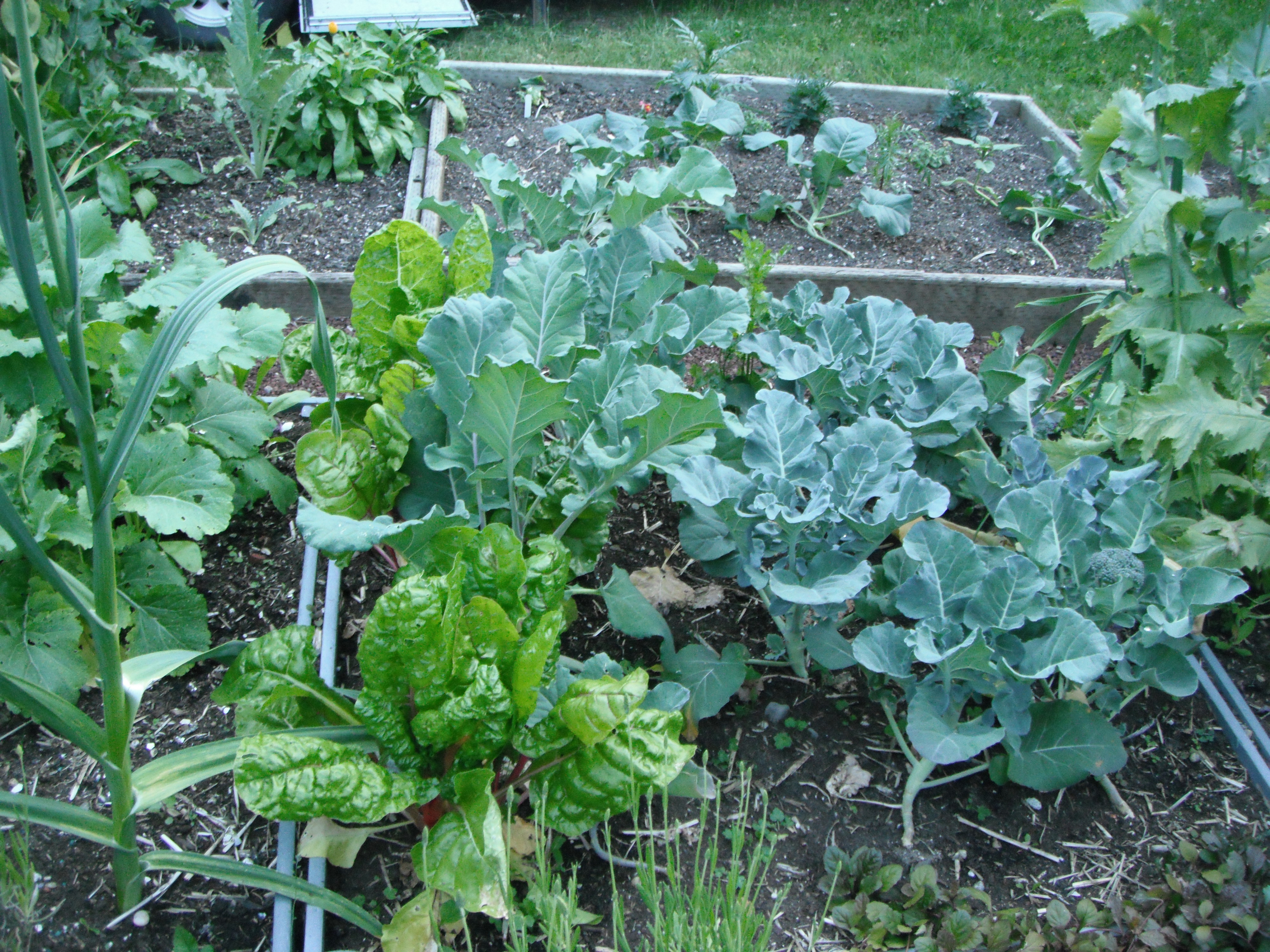
Swiss Chard & Broccoli plants in my garden.

Swiss Chard & Broccoli plants in my garden.

  If you haven’t started a garden yet this year, you may still be able to buy starts at a nursery or a farmer’s market—or start planning a winter garden.  Use a seed catalog to help you plan.  Territorial Seeds from Oregon, specialize in varieties that grow in the northwest.  When deciding what to grow, you want to grow fruits or vegetables that will yield a crop that is higher in quality and value than what you could buy in the store.  High quality vegetable crops would include: asparagus, Brussels sprouts, onions, peas, summer squash, or tomatoes; high value crops would include: broccoli, cucumbers, leaf lettuce, peppers, or rhubarb.  Fruits that are easy to grow include: strawberries, blueberries, raspberries, and plums.  Raintree Nursery in Morton specializes in fruits that grow in the northwest.  –Most importantly you need to grow what your family likes and will eat.  As you become more experienced as a gardener, you will learn what grows best for you in your location.

    You can preserve your produce by freezing, canning or drying.  Most vegetables need to be blanched (plunged in boiling water for a few minutes) before freezing; otherwise enzymes can make them bitter.  Canning takes a bit more knowledge, but fruits like peaches and pears are not difficult, and even pickles are fairly easy. For jams and jellies, just follow the recipes on the pectin package.  A good book on food preservation will have recipes and important safety tips.

    If you do not have the time for your own garden, shop at a farmer’s market to support local growers, or pay attention to where the produce comes from when you shop at your local grocery store.   Some farmers are creating co-ops—where customers can pay to have fresh, locally grown produce delivered to their house every week.

    Eating locally, sustainably, grown food will help to ensure that we will continue to have access to the sources of energy that sustains our bodies!

     (This article was first published in the Peninsula Gateway on Dec 30, 2009 as Value Makes Farming Worthwhile)

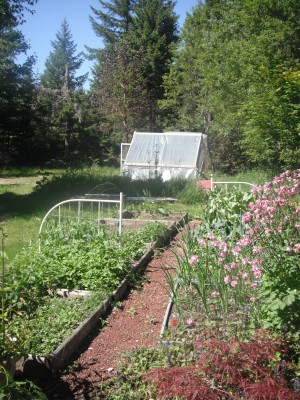
Feature Photograph: My raised-bed vegetable garden & cold frame in the background.

Creating a Wildlife Habitat

    Several months ago, I wrote a column about discouraging pests, such as deer, moles and rodents, in your garden.  I had a reader take issue with my suggestions, such as blocking access to shelter in buildings; removing birdfeeders (temporarily, at least); and managing your trash properly to discourage unwanted diners.  I intended to give people greener options for dealing with garden household pests, not to discourage all wildlife.

    Habitat loss is the biggest cause of species extinction on our planet.  The best way to combat that trend is to protect existing wild ecosystems, to restore disturbed habitats, to limit human population growth and speculative new construction to areas already impacted by development, and to plan landscapes to encourage appropriate native wildlife.

When you plan landscapes, it’s important to not merely focus on aesthetics but to balance the needs of wildlife with the needs of people.  We cannot, however, allow wildlife to decimate our crops or livestock, or spread disease; and although I would be thrilled to see a bear, cougar or pack of wolves at a safe distance, I shudder to think of dangerous close encounters.

    The best way to encourage wildlife is to re-create habitat.  Our national parks and wildlife refuges have rules against feeding wildlife for several reasons, mostly to protect the health and safety of people and wildlife.

    Feeding wildlife disrupts predator/prey relationships.  Studies have shown, for example, that feeding corvids (jays, crows, etc.) can increase the populations of those birds, and they in turn eat the eggs and young of other birds.

   People or pet food is often not good nutritionally for wild animals and can spoil more readily than food they normally wood cache.  Wild food they forage for themselves is best.   

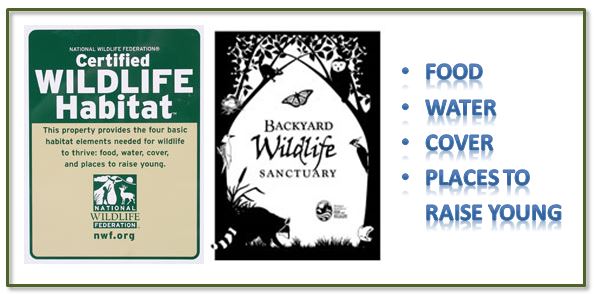
    The National Wildlife Federation’s “Certified Wildlife Habitat” and the Washington Department of Fish and Wildlife’s “Backyard Wildlife Sanctuary” are programs that will officially recognize your efforts to foster wildlife in your backyard.  They are great educational programs for children.

    In order to qualify, you need to do the following:

  • Provide food for wildlife.  Plant native trees and shrubs that produce berries, seeds or nuts, foliage and flowers.  Birdfeeders bring birds up close and are a great way to learn about songbirds.  There is less of a danger for creating a dependency with songbirds, because they can easily fly to other locations to search for food, except when they are nesting.  When you feed the birds, it’s for your entertainment and education, not for them. Burrowing animals and some insects such as butterflies need a wildflower meadow; these smaller animals and insects are prey species for larger predators.
  • Supply water for wildlife.  If you have no natural water feature, you can start by installing a bird bath or fountain.  A pond with plenty of algae and other microorganisms is a necessity for amphibians.
  • Create cover for wildlife.  Wildlife needs places to hide to feel safe from predators and inclement weather.  Evergreen trees, bushy or thorny shrubs, brush piles, cavities in old trees or stumps, niches in rockery, or man-made shelters such as bat boxes all make good hiding or nesting places.
  • Give wildlife a place to raise their young.  Wildlife needs safe places to incubate eggs and raise their young.  Many birdhouse designs are available to buy or build.  The folks at Wild Birds Unlimited in Gig Harbor can help you choose different types of feeders, shelters or houses.
  • Finally, let your garden go green.  Practice soil and water conservation, control exotic species, and garden organically.  Then you can certify your garden as a “Backyard Wildlife Habitat.”

 (This article was first published in the Peninsula Gateway on July 20, 2011 as Garden for People and Wildlife.)


« Older Entries Recent Entries »